Introducing the Climate Intervention Futures Initiative: Building Conceptual Infrastructure for a New Frontier of Climate Action
As climate impacts accelerate and progress on mitigation continues to lag, ideas that once sat at the speculative edge of climate research are edging toward more serious attention and consideration. Climate intervention strategies, sometimes called geoengineering, can no longer be dismissed as fringe thought experiments.
Approaches ranging from stratospheric aerosol injection and marine cloud brightening to glacier stabilization and enhanced weathering, are being researched, debated, and in some cases tested or commercialized. Some, such as carbon dioxide removal approaches, have already become relatively familiar parts of climate discourse, while others remain highly controversial.
As this shift occurs, questions of governance have moved to the forefront. Who gets to decide whether these approaches are researched, developed, or used? Who bears the risks? Who benefits? What forms of oversight are needed? And ultimately, who has the authority to shape the future climate?
These are urgent questions. They are also not new ones. Researchers, practitioners, and affected communities have been grappling seriously with questions of climate governance, justice, and legitimacy for years. Climate intervention governance discussions sit within this context—and within broader histories of climate and Earth system science, ecology, and longstanding conversations about technology, innovation, and power.
What lends these questions fresh urgency is not just that the technologies are advancing, but that choices are already being made explicitly and implicitly, deliberately and by default. Communities, nations, and regions are shaping the trajectory of climate intervention through what they fund and what they ignore, what they permit and what they foreclose, what they debate openly and what they allow to be decided quietly.
The question is not whether these choices will be made. It is whether they will be made well. The Climate Futures Intervention Initiative (CIFI) enters this space not to resolve that conversation, but to help build its conceptual foundations. We’ve deliberately chosen two words in our name. Here’s why.
Interventions: Understanding the Object of Governance
Much of today’s climate intervention debate is driven by a well-justified and necessary concern about governance, legitimacy, justice, and power. But before considering how climate intervention should be governed, it helps to clear the murky water simply by asking: what is it that we are actually trying to govern?
We chose the word ‘intervention’ because it is concrete. It is the human action that is subject to human control and steering.
For any climate intervention, there is first the intervention itself: a human action, carried out in time and space. This could mean injecting particles into the stratosphere, insulating glacier surfaces, or building infrastructure to remove carbon from the atmosphere. Then there are the outcomes: the intended goal (for example, reducing average temperatures or slowing ice sheet loss), and the wider ripple effects that may follow. Between the intervention and outcomes lies the Earth system itself—atmospheric dynamics, ocean circulation, cryospheric feedbacks, ecological responses, geophysical processes—all of which mediate what happens next.
Humans can only govern the intervention itself: whether it happens, who funds it, where it happens, under what rules, at what scale, and with what oversight. The Earth system’s response is not governable in the same way. Outcomes are, in a meaningful sense, co-produced between human action and Earth system dynamics.
This distinction is more than semantics and matters enormously for governance design. If we treat interventions as though they directly deliver their intended outcomes, we end up designing governance for a world that does not exist. We also make it harder to reason clearly about risk, uncertainty, and the genuine limits of human control.
This is also why we urge caution about adopting “climate stabilization” as a new umbrella term for the field, gathering this emerging space under calmer, more strategic language. The intention of many interventions may be to stabilize temperatures, rainfall, coastlines, sea ice, or crop conditions. But in a dynamic, interconnected Earth system, stabilizing one variable almost always means shifting, redistributing, or perturbing others. Stabilization describes an aspiration, not a guarantee. Building that aspiration into the category name risks conflating what is intended with what will be delivered.
Recognizing this distinction between intention and delivery, does not weaken the case for governance. It strengthens it by clarifying what governance can and cannot be reasonably expected to do.
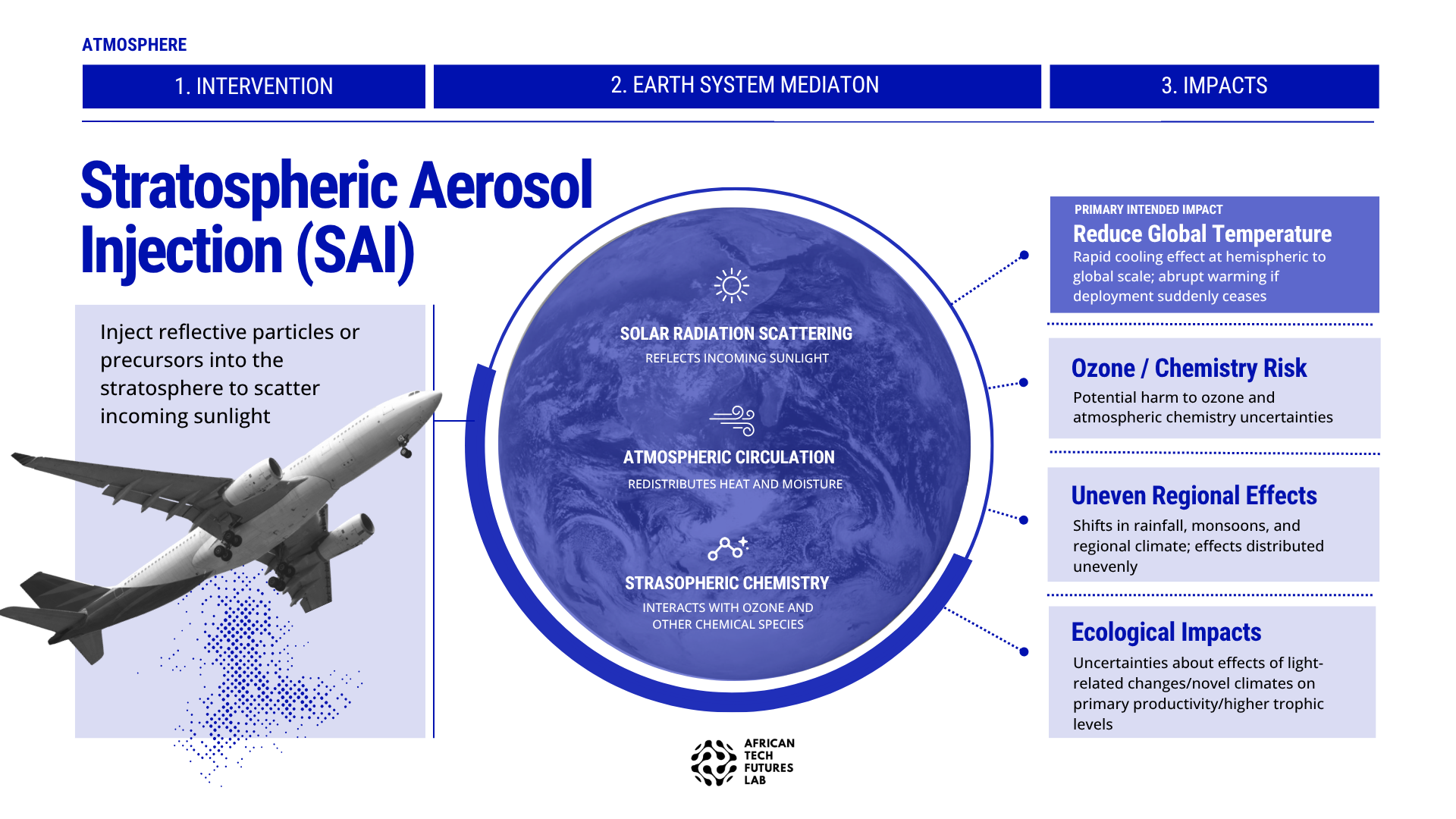
Figure 1: Stratospheric Aerosol Injection (SAI) taxonomy card depicting the (1) Intervention (2) Earth system mediation, and (3) Impacts. The primary intended impact is highlighted in the top box on the right.
Futures: Expanding our Understanding of Governance Itself
We chose the word futures, in plural, because it highlights both what is at stake and the breadth of the dynamics that shape it.
When people hear the word “governance,” what often comes to mind is formal authority: a treaty, a law, an institution with power to permit or prohibit. Those actively engaged in the space are aware that this image is far too tidy. To quote Oran Young’s 2017 Governing Complexity, governance is better understood as the wider set of “social structures for steering toward collectively preferred outcomes and away from less preferred outcomes.” These structures include institutions, standards, public narratives, funding channels, diplomatic processes, research cultures, legal systems, informal networks, and the norms they establish across society.
This matters because, in practice, the structures that shape the trajectory of a technology or field are diverse and dynamic. They include which questions researchers are funded to ask, how media frames an emerging technology, which communities have voice in deliberations, what financing flows toward or away from a domain, which analogies and precedents get drawn into the conversation, and the broader crises, shocks, and shifts that expand or contract what societies are willing to consider or act on. A narrow understanding of governance in the climate intervention space forecloses a much larger set of levers and a much richer set of questions about who is actually shaping the field and how.
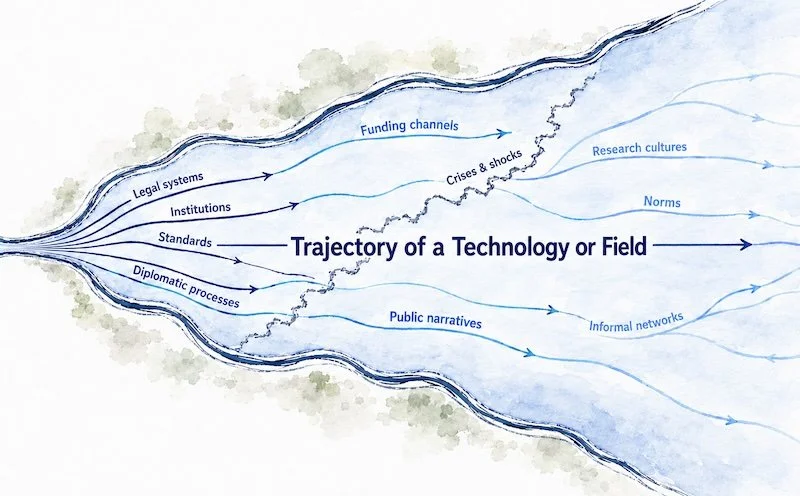
Figure 2: The trajectory of a technology or field is shaped by a wide range of structures, from formal and visible to less conventional but equally consequential. Governance, understood this way, functions like river currents that widen the possibilities of what a field can or should become, rather than a dam that simply permits or prohibits.
Building foundations for a broader conversation
A broader, more inclusive, and more effective conversation about climate intervention governance starts with building firmer conceptual ground. This requires a clearer, more honest account of what climate interventions are, distinguishing human action from the Earth system processes and outcomes they set in motion. We must then pair this with a deeper understanding of the diverse possibilities for influence, steering, and accountability that different interventions create.
Crucially, this conceptual work cannot be done once and set aside. The technologies, the governance conversations, the political landscape, and the climate crisis itself are all evolving. These foundational governance questions need to be asked and answered iteratively, in close dialogue with that evolution.
What comes next
Getting the “what” right is crucial and often underappreciated conceptual work. A governance conversation built on a blurry or distorted account of its object, or on an impoverished understanding of the tools available to shape it, will struggle to find solid ground no matter how sophisticated it becomes.
At the Climate Intervention Futures Initiative (CIFI), we’re starting with two workstreams:
A new taxonomy of climate intervention: We are proposing a framework that represents each intervention through three connected elements: the human action itself, the Earth system processes that mediate what follows, and the outcomes—both intended and otherwise. By making this structure explicit, the taxonomy helps clarify what governance can actually steer, and where the limits of human control lie. It also surfaces the ways in which different interventions raise very different governance questions, some that have been largely overlooked. The taxonomy will be presented in a forthcoming report, which maps 75 climate interventions across the categories introduced here.
Learning from comparative histories: Climate intervention is not the first complex, contested, high-stakes domain in which societies have had to steer research, development, and the potential use of new tools under deep uncertainty about their implications. We’re examining a wide range of historical cases, spanning diverse fields such as nuclear energy, weather modification, assisted reproduction, the internet, artificial intelligence, and managed ecosystems. These cases do not offer simple analogies or ready-made lessons. Instead, they build a richer vocabulary for how governance actually takes shape: what kinds of steering structures emerge, how they function, under what conditions, and with what consequences. This historical perspective can give us a more grounded sense of what governance really is, and the range of possibilities for steering climate intervention more wisely. We will be sharing this work as it develops over the coming months, and welcome engagement with others thinking about similar questions.
The climate intervention field is moving quickly. The conceptual infrastructure for governing it needs to move too.