What Does It Mean to Build African Capacity? A Conversation with Youba Sokona
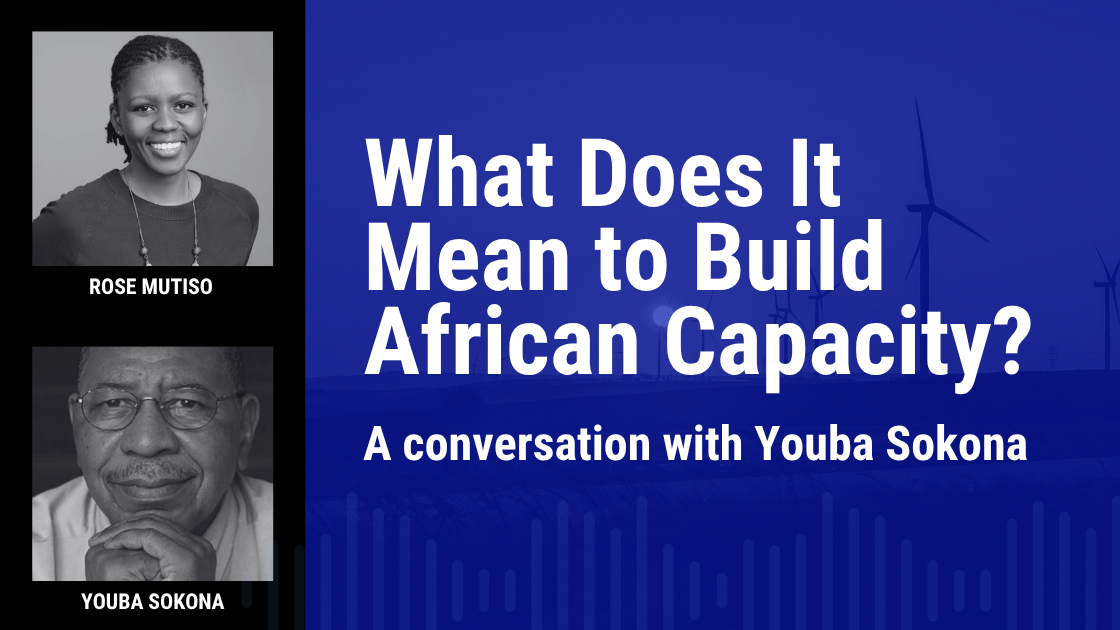
Listen to the full episode above. This is a joint production of the African Tech Futures Lab and the Energy for Growth Hub. Produced by Audrey Zenner.
Mali is in the headlines a lot these days…coups, instability, geopolitical realignments. But when I think of Mali, I think of two things: Ali Farka Touré, one of the greatest musicians Africa has ever produced, and Prof. Youba Sokona, one of the continent's most important and under-celebrated thinkers on energy, climate, and development.
Youba has been in this space for more than four decades. That phrase — *four decades* — is easy to say and hard to absorb. It means he was working on energy poverty before it had a name, before SDG7, before the clean cooking coalitions and the off-grid finance forums. His entry point was the Sahel droughts of the late 1970s, which converged with what he calls a second energy crisis — not oil this time, but firewood and charcoal. The crisis of people burning down their landscapes to cook and stay warm. At the time, he was a PhD student in France, watching a movement of appropriate technologies try to find answers.
He decided to join it, driven by what he describes as a simple but powerful observation: that no meaningful development is possible without energy. Water, schools, hospitals, irrigation are all impossible without energy.
He got into this field not as an energy person, but as a development person who understood what energy unlocks.
That framing has never left him.
One of the things I find most remarkable about Youba's career is how he has operated across every scale simultaneously — from village-level energy planning in West Africa to the very top of global climate diplomacy. He served as Vice Chair of the IPCC Working Group III and was, for many years, one of only a handful of Africans in those rooms. He almost didn't stay. When he first arrived at an IPCC meeting in the nineties, he looked around at conversations about climate science and economics and decided he had nothing to contribute. It took pressure from colleagues who frankly needed an African face at the table for him to stay.
He stayed. And then he changed the conversation.
His most vivid example: when he was co-chair of the Working Group III for the Fifth Assessment Report, the first draft of the energy chapter contained twenty pages on nuclear energy and a single paragraph on firewood and charcoal. "This is the life of billions of people," he told the authors. Not only did he object, as an African coordinating lead author he made sure the revision reflected the energy realities of the Global South. Over time, he and colleagues from Latin America and Asia pushed the IPCC to take development seriously alongside climate science. We now take for granted that adaptation, loss and damage, and climate justice have a seat at the table in global climate deliberations. People like Youba are a big reason why.
He did all of this, he notes, with characteristic bluntness, with essentially no support. His German co-chair had fifteen PhD researchers backing him across different topics. Youba had nobody.
The concept that runs through everything Youba does — and that I think is the most important thing to take from this conversation — is his distinction between capacity as ‘training’ and capacity as ‘agency’.
We hear capacity building language constantly in development circles. Youba argues that the term has been so thoroughly captured by a flawed model that we should retire it. In his framing, the dominant approach treats capacity as something Africa lacks and must receive i.e., a one-way transfer from north to south, from expert to novice, from outside in. The result is what we all recognize: thousands of workshops, trainings, and pilots that arrive, create little local ownership, and disappear.
His alternative: "Capacity is not the ability to implement someone else's agenda, but the ability to define and pursue your own." And critically — capacity isn't just about individuals. A PhD scholar, he says, cannot perform miracles if there is no research fund, no data systems, no institutional support. The real gap in Africa is it’s institutions. Ask yourself to name five strong African energy and climate research institutions. It's hard. Ask the same about the UK and you'd run out of time.
This is what animates AISESA (the African Institute for Sustainable Energy and Systems Analysis), the institution Youba has been trying to build for fifteen years. He developed the concept long before the money or political support materialized. COVID, unexpectedly, provided a model: when the IPCC produced reports remotely during lockdown, Youba realized that a virtual network of African experts, wherever they are in the world, could function as a kind of institution. Today AISESA brings together around two hundred researchers, from Bamako to Beijing, contributing time and expertise on their own terms.
It's an honest and pragmatic compromise. The long-term vision of rooted, funded, institutionally anchored African research centers remains elusive. But this flexible, diaspora-spanning network is a way to start moving without waiting for donors or governments to catch up. "I will not tell you to leave China or Japan or Canada," Youba says to the African researchers scattered across the world. "But can you give us a tiny part of your time and your knowledge?"
Youba Sokona is one of my personal heroes. He is a wise, principled truth-teller who has never stopped pushing, in every room he has entered, for African agency over Africa's future. I hope this conversation is as meaningful for you to listen to as it was for me to have.