
A New Taxonomy of Climate Interventions
In order to govern climate interventions well, we need to be precise about what we can actually steer. This taxonomy is a first step.
This work builds on the conceptual framing introduced in our previous post here.
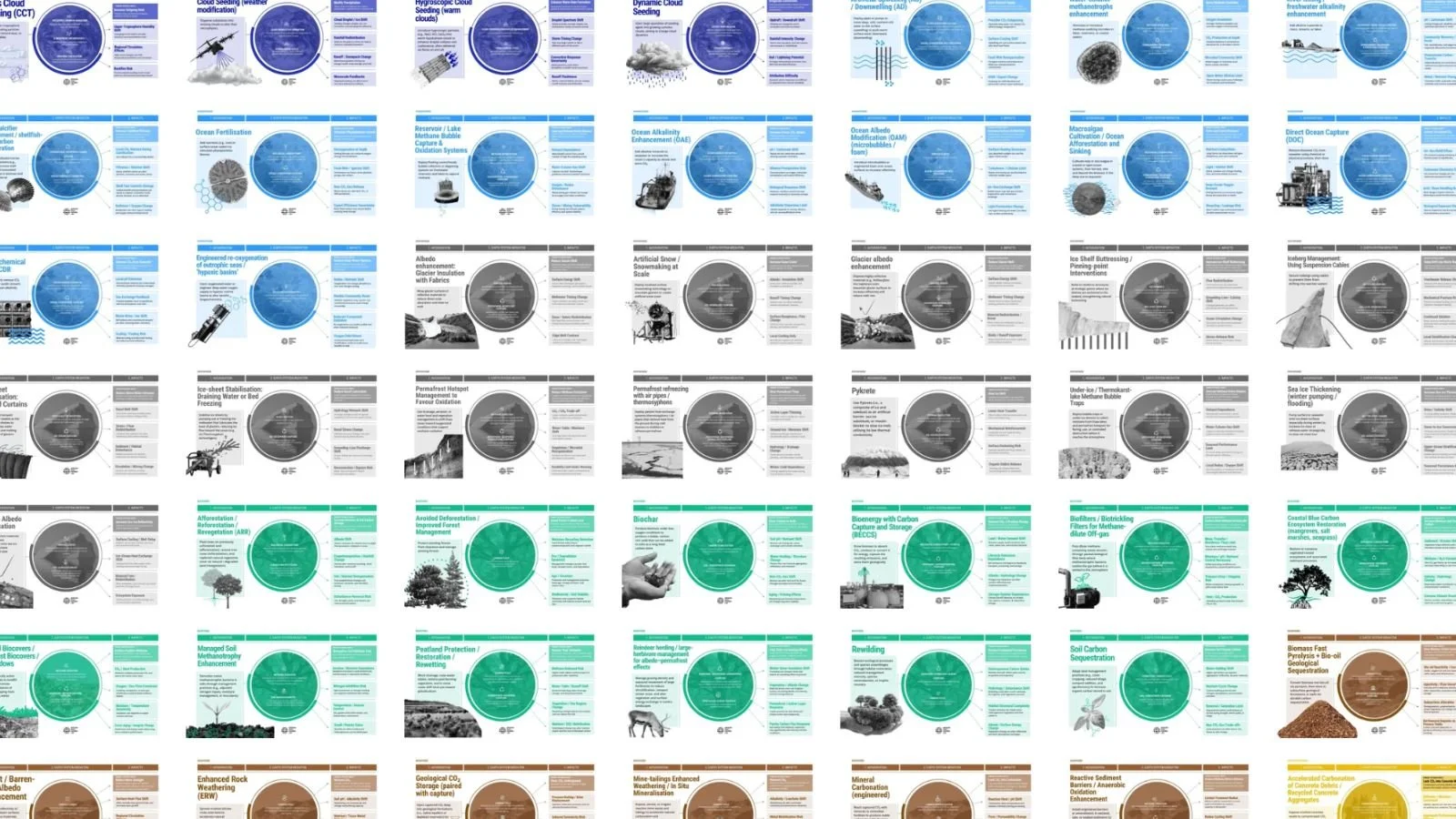
75 cards organized by the Earth system sphere where each intervention begins.
Why we need a new taxonomy
Vastly divergent approaches, from stratospheric aerosol injection to enhanced weathering to glacier stabilization, have been bundled under unstable umbrella terms: geoengineering, climate cooling, solar radiation modification, climate stabilization, and even climate intervention itself. But these human actions differ in mechanism, scale, reversibility, visibility, infrastructure, actors, and how much control any institution could plausibly exercise. Some are highly speculative; others are already embedded in existing systems. Some are easy to monitor, like glacial stabilization; others, like marine carbon dioxide removal, are hard to assess and attribute to particular interventions. Lumping these diverse approaches together has often obscured more than it's clarified.
This taxonomy is designed to make those differences visible.
Rather than starting with a single umbrella category or an assumed outcome, it begins with the human action itself: what is being done, where, by whom, and in which sphere of the Earth system. Then, which aspects of the Earth system mediate the outcomes—both the intended and unintended ones. Earth system dynamics have their own chemical, physical, and biological logics that are distinct from the human actions that governance steers.
Getting the "what" (is governable) right is what makes a more constructive conversation about the "how" (to govern) possible. For those who question whether climate intervention can be governed, the same logic applies. The taxonomy helps clarify what aspects of outcomes are and are not a simple function of the human actions that governance seeks to affect.
Who this is for
This taxonomy is an invitation to researchers to study what's been overlooked; to policymakers, to reckon with what's been on and off the table; to the public, to participate in shaping terms that have so far been set narrowly; and to the climate field as a whole, to take the "what" seriously so the "how" has firmer ground. We can also see practitioners using it as a working reference and educators as teaching material. We welcome comments, suggestions, and updates where we may have missed an aspect of the intervention, Earth system mediation, or impacts.
How to read the taxonomy
Cards are organized by the Earth system sphere where each intervention begins: atmosphere, hydrosphere, cryosphere, biosphere, geosphere, anthroposphere, exosphere. Each card reads left to right across three connected elements:
The intervention or the human action itself: what's being done, by whom, where, at what scale.
Mediation through the Earth system: the atmospheric, oceanic, cryospheric, ecological, and geophysical processes that translate that action into effects. This "in-between" layer is often left implicit, even though it's where most of the uncertainty lives.
Impacts: the intended goal, and notable wider ripple effects that may unfold beyond it.
This structure is meant to interrupt the assumption that human action maps neatly onto climatic or social effects. The most consequential governance questions aren't only "who decides" or "who deploys", they're also "how could this travel through the Earth system," and "what outcomes does that make more or less likely?"
What this does—and does not—cover
The taxonomy does not judge which approaches are "good," "bad," "acceptable," or "unacceptable," nor does it try to fold questions of justice, power, legitimacy, or political economy into one flattened frame. What it does is create a legible, structured foundation those debates can happen on, without merging them prematurely.
We've drawn a working boundary around what counts as a "climate intervention": a deliberate human action intended to alter the Earth system in ways relevant to weather or climate. That's narrow enough to give the taxonomy shape, but the edges are even still murky. Readers and users can adjust that boundary for their purposes.
Where climate intervention ends and adaptation, infrastructure, or environmental management begins is an open question we expect to continue testing as this work continues.
What the taxonomy makes possible
A more precise vocabulary. Each card represents a distinct approach to intervention with its own mechanism, scale, infrastructure, and Earth system entanglements. It makes visible, at a glance, why they should not be bundled. In practice, this means stepping away from sweeping references to "geoengineering" or other umbrella terms when what's often actually being discussed is one specific technique.
A wider field of view. Stratospheric aerosol injection (SAI) has often stood in for climate intervention as a whole. Situating it within a broader landscape allows it to be discussed on its own terms, while creating room for other approaches that look and behave very differently. A shared map surfaces approaches that have been neglected for not fitting under the dominant umbrella terms, and motivates a wider conversation about the variety of control and decision-making possibilities the field actually contains.
A stronger basis for risk-risk analysis. Laying out actions, goals, mediation, and downstream effects side by side moves the comparison beyond a single intervention versus a "do nothing" baseline, toward comparisons across interventions, against the risks of continued warming, and across each approach's trade-offs.
A sharper view of what governance can steer, and what it can't. Separating what humans do, what we intend, and how the Earth system mediates the rest clarifies where steering is genuinely possible and where it's more limited. Once Earth system mediation is made explicit, the question shifts from "who has the power to direct the technology" to "who has the authority to choose among possible distributions of risk and benefit”. These are different questions, implying different governance arrangements.
Explore the cards below by sphere, or download the full set as graphics or as a searchable spreadsheet.
This is a living taxonomy, and we welcome input—you can share feedback here.
Acknowledgements
This report was developed through a collaborative process. Trisha Patel led the core intellectual development of the taxonomy, including much of the conceptual and analytical work that shaped the final framework. Grace Tamble led project management, contributed to content development, and supported the graphic design translation of the taxonomy. Jessica Seddon and Rose Mutiso provided framing insights, context- and subject-matter expertise, and critical feedback throughout the process. Eleanor Mayrhofer led graphic design conceptualization and development. Bob Lalasz contributed strategic communications guidance. We are also grateful to our funders and the many stakeholders, researchers, practitioners, and governance experts whose work and perspectives informed our thinking.
