
In 1974, climate scientists writing in Science mused about creating “stratospheric smog” or putting mirrors into orbit as a way of achieving climate stability.
William Kellogg and Steve Schneider’s “Climate Stabilization: For Better or for Worse?” identified three options when it came to climate change—doing nothing, altering patterns of land and sea use to lessen the impact of climate change (i.e., adaptation), or “anticipating climate change and implementing schemes to control it.” They were writing while CO2 was 320 parts per million and “mitigation” was not yet a term of art in climate change response. The “objective of climate control,” they write, would include counteracting inadvertent human influence as well as cushioning the effects of seasonal anomalies (this year, one thinks of El Niño). “That is what we mean by stabilizing climate.”
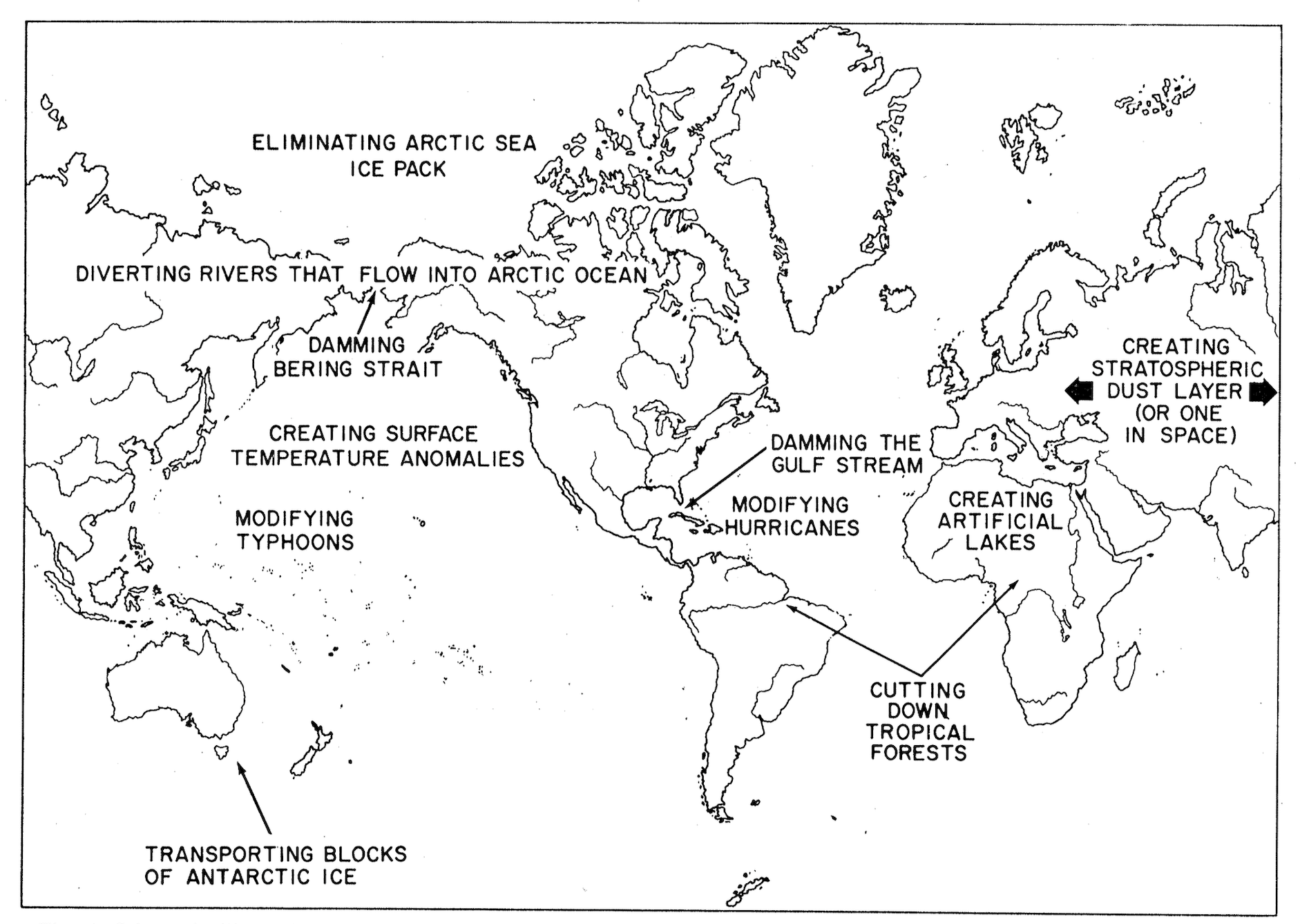
Figure 1: Kellogg and Schneider illustrate examples of “engineering schemes” that could be proposed to “modify or control the climate” in their 1974 paper [1].
Kellogg and Schneider also noted the “difficulty of deciding what different peoples of the world will accept as an ‘optimum climate’ toward which we should aim our stabilization schemes.” Fifty years later, this is still a central topic in discussions of climate interventions, or geoengineering [2]. Writing in 1974, these scientists anticipated issues we are still debating with climate intervention—how raw power and interests determine action rather than rational discourse or ethical principles, causality and liability, and the atmosphere as a shared resource. In the end, they argued not for doing geoengineering, but for crop insurance and humanitarian relief.
In the decades since “Climate Stabilization for Better or for Worse?” was written, the focus of “stabilization” became greenhouse gas concentrations, not climate interventions. Stabilization was enshrined as a goal in an international treaty, shifted towards becoming about stabilizing temperatures, and envisioned as happening through a global energy transition from fossil fuels to clean energy systems. And now, in 2026, the term “stabilization” has come full circle, in a somewhat modified form, to be refocused on geoengineering and climate interventions by a group of Silicon Valley funders and advocacy organizations.
Whether this is a good development, why it is happening now, and what it means for climate action and politics is the focus of this article.
A Brief History of Climate Stabilization
Climate stabilization as an actual policy goal began to emerge in the 1980s. The United Nations Framework Convention on Climate Change, signed in 1992, is framed in terms of stabilization: as stated in Article 2, the “ultimate objective” is “stabilization of greenhouse gas concentrations in the atmosphere at a level that would prevent dangerous anthropogenic interference with the climate system.”
The second Intergovernmental Panel on Climate Change report in 1995, coming after the 1992 UNFCCC treaty, was framed squarely in terms of stabilization of greenhouse gas concentrations. It used “stabilization profiles” to examine illustrative pathways for stabilization of greenhouse gas concentrations at different levels, S350–S1000, the “S” standing for stabilization and the numbers for different parts per million of CO2.
How would stabilizing greenhouse gas concentrations happen? “Stabilizing the carbon dioxide-induced component of climate change is an energy problem,” began the abstract of a 2002 review in Science about “advanced technology paths to global climate stability.” This paper did consider geoengineering as an insurance policy, at the end, but its core argument was that new energy sources and moving off fossil fuels were needed to achieve climate stability.
Completely restructuring the energy system still seemed a bit far-fetched at that time, but to make this seem more tractable, Princeton scientists Stephen Pacala and Rob Socolow published a 2004 piece in Science called “Stabilization Wedges: Solving the Climate Problem for the Next 50 Years with Current Technologies.” This paper offered a portfolio of actions—within categories of efficiency and conservation, decarbonization of electricity and fuels, enhancing natural sinks—that could be done to stabilize the climate. It was in part a response to the discussions of advanced technologies like nuclear fusion in the abovementioned 2002 review in Science, the key message in the stabilization wedges paper being that we had all the technologies we needed to stabilize climate at 500 ppm (Figure 2). (The stabilization wedges framework was recently critiqued in a ProPublica article for having been influenced by the fossil industry sponsor, BP).
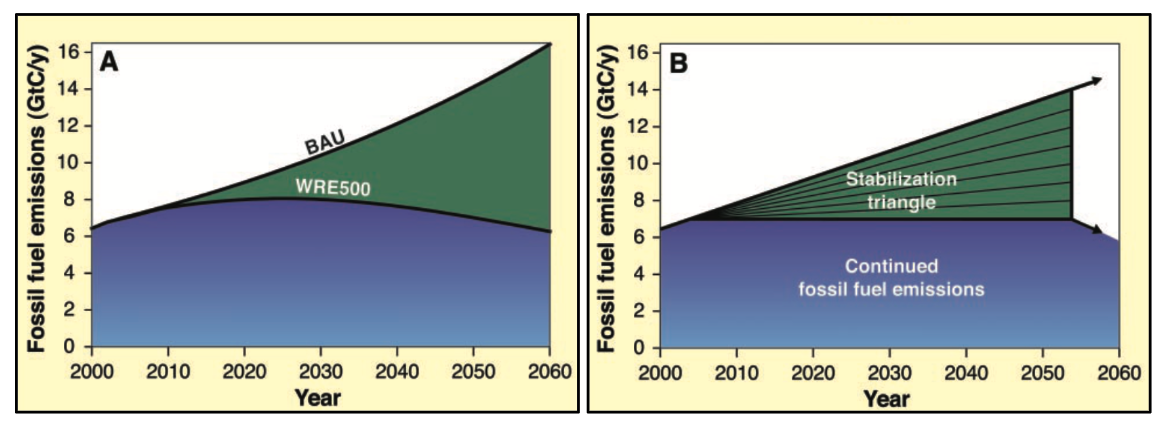
Figure 2: Pacala and Socolow’s “stabilization wedges,” introduced in a 2004 paper to illustrate how greenhouse gas emissions could be “stabilized” at 500ppm with existing technologies [3].
But the point remains that Pacala and Socolow’s paper set out a physical metaphor for how to do stabilization—the wedge—that had lasting influence. The stabilization wedges have been updated over time by different research groups to include behavioral wedges and new technologies and practices, from heat pumps and new industrial decarbonization approaches to dietary shifts, flying less, and planting trees, as described in a new paper (again, in Science): “Democratizing climate change mitigation using modernized stabilization wedges.” The basic idea here remains that we shouldn’t give into despair, because there are a whole bunch of things that can be done to stabilize the climate, and together they all add up.
Over time, the object of stabilization shifted from “greenhouse gas concentrations” to “temperatures”—specifically, global average temperature, averaged over time. Better scientific evidence about the relationship between concentrations and temperatures helped this move, which was traced in a 2011 National Academies of Sciences committee-run study, “Climate Stabilization Targets: Emissions, Concentrations, and Impacts over Decades to Millennia.”
We know what needs to be done to stabilize temperatures: as stated plainly by the Intergovernmental Panel on Climate Change, “limiting human-induced global warming to a specific level requires limiting cumulative CO2 emissions, reaching at least net zero CO2 emissions, along with strong reductions in other greenhouse gas emissions.” If global emissions are equal to global removals, within a few decades, temperatures will level off.
This is generally true, with the caveat that if net zero is reached later in this century rather than in the next few decades, and therefore more cumulative carbon is emitted, feedback loops from global warming (such as permafrost melt) may mean that even net zero does not stabilize warming, and net negative emissions, accomplished through carbon dioxide removal, are required. But the main point is that stabilizing temperatures requires at least net zero CO2 emissions. As the world passes the 1.5°C target, growing discussions of “overshoot” will prompt further discussion of what a “stabilization phase” entails.
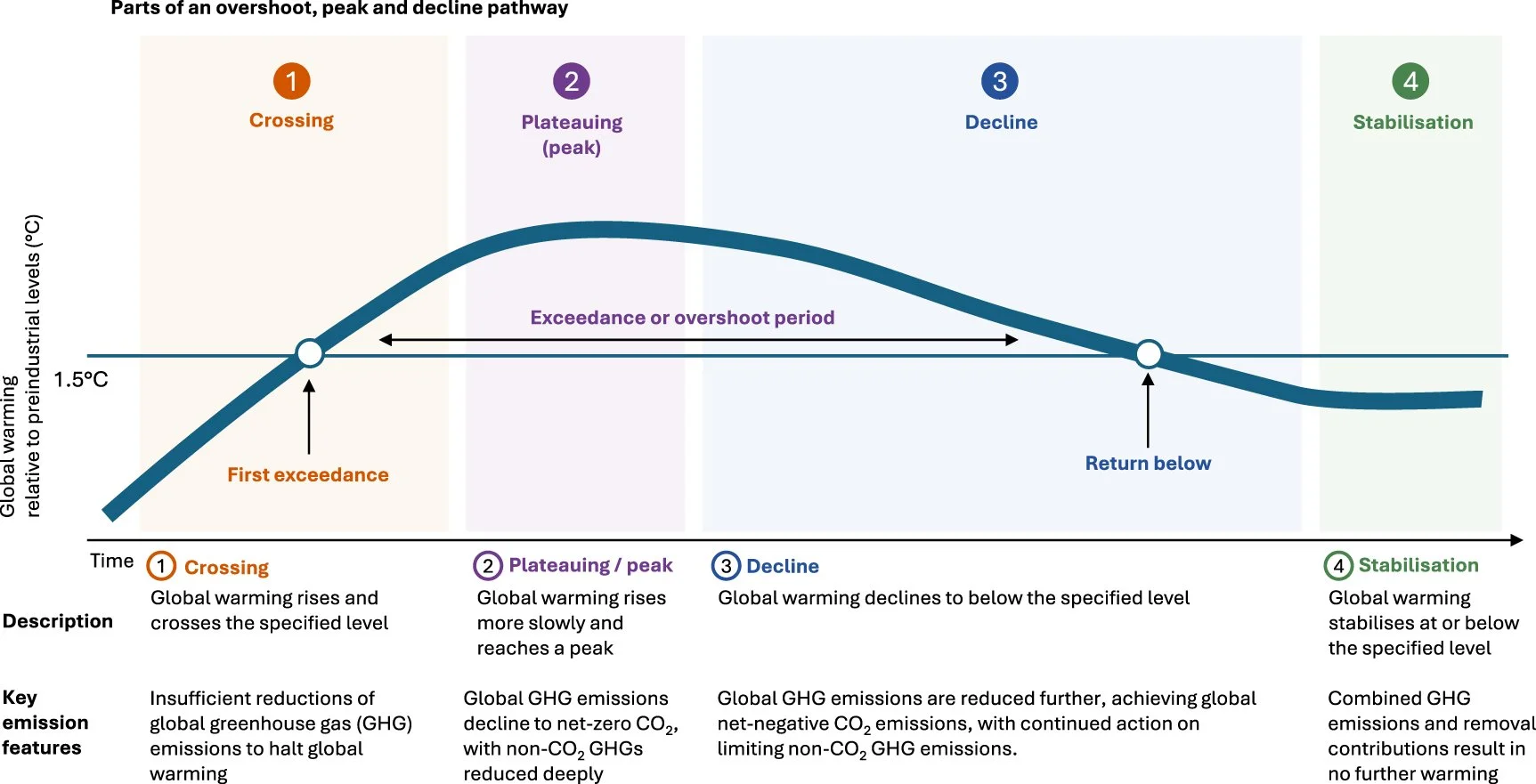
Figure 3: Schematic showing global average temperatures overshooting the 1.5°C target, followed by peak, decline, and stabilization phases, from a 2026 paper by Rogelj et al. on overshoot terminology [4].
Does stabilizing temperatures mean “the climate” is stabilized? That’s more complicated. Even when carbon dioxide emissions go to net zero, the deep ocean and ice sheets keep changing for centuries; the accumulated heat surplus gets redistributed in the system. So while some climate scientists use “climate stabilization” as shorthand, most of them would also be quick to bring in nuance about what that actually means—the fast climate system has a plateau, but the slow climate system is still in motion.
Scholars have argued that this complexity matters. Stabilization discourse is misleading because it offers a picture of climate change that can be predicted and managed. In a 2010 article in Global Environmental Change, Max Boykoff and colleagues highlight a key challenge of defining “stabilization” around particular greenhouse gas concentrations and global average temperatures: there are a lot of fundamental uncertainties around climate sensitivity, the carbon cycle, and so on, which is why you see a climate science literature with so many ranges in it. They also point out the psychological dimensions of “equilibrium and stability myths” as they move into NGO discourse and the wider culture—that the safe, secure climate can be engineered by our actions now; if we don’t, the future will be unsafe and unstable. Such myths, they argue, “reflect a project of bringing order to our existence” and echo other environmental debates of the 1970s, including that of population, in their “demands for global management.” Ultimately, they call for moving away from stabilization discourse, arguing that its “elegant attraction” has produced a narrow focus on long-term mitigation targets and cost-effective climate policy while obscuring broader political and ethical questions about timescales, actors, and the distribution of costs.
Rebranding Climate Stabilization in 2026
Given this decades-long history—and established critique—it may seem odd that 2026 sees a new attempt to reinvigorate and redefine stabilization discourse. But this is what is happening on the climate circuit.
“To protect humanity and bring the Earth’s energy and temperature into balance, governments need to research, develop, and test emerging climate stabilization techniques, complementing existing mitigation and adaptation efforts,” argues a June 2026 “Foreign Policy Analytics Issue Brief.” San Francisco Climate Week in April 2026 had a climate event, “Stabilize Earth,” to “lift up interventions best placed to stabilize the biosphere,” such as solar radiation modification or glacier stabilization, “measured in tenths of degrees Celsius instead of tons of carbon.”
“Is climate stabilization still possible?” asks a salon in Brooklyn in May 2026, featuring a presentation by philanthropy Outlier Projects and describing stabilization as a “third pillar” of climate response, the “third leg of the stool,” alongside mitigation and adaptation. “Many of the strategies once criticized as moral hazards are now core pillars of climate policy—and stabilization is next,” notes the writeup, which positions this as the latest climate discourse to become normalized. “Mitigators rejected adaptation as surrender, methane abatement as distraction, carbon removal as fantasy. Each crossed the moral line only after enough harm forced reframing—and stabilization is next on that line.”
In this body of conversation—it’s not quite “literature” yet, as it happens in advance and parallel to scientific discourse—the problem is partly defined in terms of declining reflectivity, and partly in terms of tipping points. An analysis posted on the Effective Altruism forum highlights how emergent science and conversations around climate system tipping points motivate the new stabilization discourse. “Stabilization targets the hazard-generating systems themselves,” the EA post explains, which are showing signs of destabilizing. This includes “declining reflectivity,” whereby as “reflective aerosols reduce, clouds thin, and ice retreats, the planet absorbs more solar energy, accelerating warming across the board,” as well as ice loss, ocean current disruption, and warming-induced emissions in natural systems.
The switch here from stabilization as mitigation—dozens of wedges of it!—to stabilization as a separate thing from mitigation and adaptation will be read as a move to make a new container in which to discuss geoengineering. It follows a history of attempts to free geoengineering from its taboo by reconfiguring the conceptual topology and the terminology: climate repair, climate intervention, climate restoration, climate protection, and now, apparently, “reflect and protect.” Academics used to debate all this. Over the past decade—with academia under strain from lack of funding and attacks from the right as well as internal polarization and silencing dynamics on the left—the locus of conceptual work has shifted to podcasts, Substacks, and, apparently, elite convenings in coastal cities, funded by tech and finance money that has a sometimes-warm, sometimes-hostile relationship with established scientific institutions.
This shift out of academia and onto a parallel conceptual infrastructure may front as a democratization of knowledge, but in actuality, it’s not. People feeling climate impacts in vulnerable countries are arguably even farther from being engaged in problem framing and decision-making than when conceptual construction was funded by EU government grants and communities formed on the back of international scientific research networks. And these people matter. A stabilization rebrand seeded and driven by a small group with a homogenous internal culture and associated blind spots is not going to work for a global challenge of this nature. It also leaves unaddressed the core issue with any climate stabilization framing, that “the climate” is not a singular object that can be “stabilized.”
What the Stabilization Rebranders Get Right
Here is where I agree with some of the effort being made this year: there are serious climate risks and tipping elements in the climate system. Policymakers, investors, funders, and civil society are not doing an adequate job apprehending climate risk or coming up with proposals to address the scale of the risks.
The scientific community is focusing on describing the risk, which is warranted, but the epistemic landscape for response measures is broken. The risk of climate change itself eroding the capacity to respond to climate change and having society stuck in a doom loop is real, although this risk is very challenging to quantify.
There are a number of forms of responding to climate change that need more research—and that research needs to be done in a thoughtful, structured, and transparent way.
A container or a typology for those forms of intervention would help people think about them and probably motivate more research funding. However, this does not mean we should necessarily adopt a new container, particularly a container that shifts the focus to promised ends that it may never be able to deliver.

Figure 4: The language of stabilization evokes the promise that the climate can be held steady and brought under control. (Photo by Maurício Mascaro from Pexels).
Stabilization is Not a Good Framing
The first issue is that climate stabilization already has a meaning and is a term of practice in climate science; stabilization as a goal and stabilization pathways have particular meanings. Talking about the “stabilization field” or “stabilization” as a pillar alongside all the other activities that have traditionally been “how you stabilize climate” will be confusing for the scientists, policymakers, and the public. And notably, the “stabilization” problem framing has not really succeeded over the past half-century in terms of delivering climate action.
Regardless, it is somewhat logical for people to think there is an opening for resurrecting the 1974 concept of stabilization in new garments. For one, the discourse around “tipping points/tipping elements—thresholds beyond which some Earth systems may shift irreversibly, think ice sheet collapse or Amazon dieback—goes hand in hand with the stabilization discourse (if something is going to tip, you stabilize it). With tipping points discourse rising in prominence, stabilization naturally will as well.
Moreover, the muscular vibe shift in US climate and politics broadly lends itself towards a posture that feels decisive and hard—stabilization has far more of this moxie than other goal-oriented language in the climate space, like “transition” or “transformation.” Stabilization sounds like it fits with gendered tasks of assembling furniture or pouring concrete. Complex systems bros mesh with vibes of ontologies and hard power built on software, VC pivots to hardtech, companies with Tolkien names, the legacy of the Californian Ideology met with the new emphasis on warfighting as well as building and doing.
There’s also a securitization element that is introduced with “stabilization.” It’s a common vocabulary in national unrest; think UN blue helmets with stabilization mandates.
And a yearning for stability makes sense from a US-focused standpoint. Things were pretty stable over the past few decades, at least for the upper-middle class involved in knowledge production. It is not easy to reckon with imperial decline, rampant corruption, and the erosion of norms, though plenty of people in the world have had to do this. When institutions are getting dismantled and wars started by chaos agents with no plan, stability is a natural goal. Ironically, this context of the rules-based order eroding also makes stabilization feel farther off, even if it is more desirable.
So the moment seems relatively promising for a stabilization glow-up. But when the objective of climate action switches to “climate stabilization”—and when climate interventions get repackaged around the aim of stabilization—this does a few things:
“Stabilization” decenters social and institutional actors in responding to climate risk. The subject who is acting here is not very clear. If your frame is “being prepared for climate change” or “preventing climate change” or “responding to climate change,” those are registers in which you can see both individuals and institutions acting. A person can wrap their heads around being prepared for climate change, even if it feels like a tall ask. They can also think about the systems they’re embedded in preparing for climate risks, or preventing them by adopting new technologies and practices. If it’s “stabilizing climate,” that’s hard for an individual or particular actor to have agency in. Your town’s sustainability office might have an open house about preparing for climate change where you talk about concrete things you can do, whether that’s cooling centers or making your neighborhood wildfire-ready; your company might have a meeting about its risk mitigation strategy. But chances are neither of them will convene a discussion about how they will work on climate stabilization in the next fiscal year.
Stabilization presents an inaccurate picture of what is actually happening to the planet. Solar radiation modification is likely to stabilize global mean temperature, but create novel biospheric conditions, because the amount and type of sunlight is being changed and CO2 emissions would be decoupled from temperature. This would be a new situation for ecosystems, in ways that have not been seriously researched. As a recent piece by ATFL’s Climate Intervention Futures Initiative noted, stabilization describes an aspiration, not a guarantee. Stabilizing temperatures is not the same thing as holding the climate steady. Ultimately, it’s the planet itself that does the stabilizing.
Stabilization elides questions about whose baseline is being stabilized—and whose is being destabilized by stabilization itself. This is the same question that was asked in 1974, though from many more voices. For much of the majority of the world, things have not been stable at all. Indeed, for communities who have lived through colonialism, extraction, and displacement, “stability” was rarely on offer to begin with. Stabilization language casts political acts in terms of neutral systems maintenance, obscuring whose reality and power is actually being protected. It may remind people of the policy playbook of the Washington Consensus: stabilize, liberalize, privatize. With regards to both security matters and macroeconomic stabilization, there’s a history of “stabilization” being something that global institutions like MONUSCO (the UN’s longstanding peacekeeping force in the Democratic Republic of Congo) or the IMF do for or to the Global South. These resonances also bring up questions about agency and control: who chooses the target, whose version of stability is being protected, and who lives with the consequences if stabilizing one system destabilizes another? Stabilization is the promise of autocrats: what they appear to offer, but for a high price. We might not want to open that door.
“Climate stabilization” bounds the goal and the action space. If the object of stabilization is “the climate,” or even “earth systems,” that might leave out ecosystems; ecological repair is a broader frame. And what people really care about in terms of “stabilization” is probably human systems—finance, food systems, political systems. Some argue that the current arrangement of those systems is itself the problem, so stabilizing isn’t the right goal. This is part of why “transformation,” in terms of fundamental, system-wide change, came up in international platforms like IPBES, the intergovernmental body that assesses biodiversity. Of course, people argue that we do not have time to change all of society with earth systems unraveling, and a narrower, more urgent goal like “climate stabilization” is exactly the point. This old debate about quick climate action vs. slow systems transformation hinges on a false binary. There actually is no climate action without some of the transformative work: durable climate policy requires real voter buy-in; a global transition requires some real delivery of promised climate finance from the global North to the South; and fossil-fuel-dependent economies will need help transitioning. This does not mean that every item people like to place in the “transformation” wishlist is required, but the evidence indicates that a world that successfully mitigates climate change does make different social and policy choices. It is the investment in social support and institutional change that unlocks climate action. “Climate stabilization” as a goal that is taken up by funders and policymakers—the intended audience for the discourse—may indeed divert attention from those investments.
Just Call It What It Is
If “stabilization” doesn’t work—as a container for emerging climate intervention ideas, or as a goal for climate action—where should we head instead? If climate change has been getting worse over fifty years of stabilization talk, it seems likely we need new ideas and new ways of seeing the world from new places.
Genuine multicultural dialogue with people who have been left out of framing the problem and the solution space would be quite generative, and probably lead to better results.
When it comes to the container problem, we have the option to simply not consider this as a problem, and just call things what they are. Where does this desire to taxonomize come from? It doesn’t change the work that needs to be done. Who is the sales pitch to? A specific program can pursue Arctic sea ice restoration or glacier stabilization and just use those terms without needing some umbrella category. Many of these interventions are more honestly described as partial interventions against specific non-linear risks, not stabilization of the climate as a whole. When it comes to climate intervention, just treat each idea on its own terms. This will be useful in communication—many people prefer plain, specific language and are skeptical of fuzzy categories.
When it comes to what to do to actually stabilize the climate, the essence of what’s needed is more like flexibility and the capacity to respond to surprises, as well as social infrastructure. If society wants to implement multi-decadal infrastructure projects, which is what many of the “stabilizing interventions” are, there needs to be durable social and relational infrastructure to support them, from genesis to operation to sunsetting. Society needs to get over these gendered binaries where social infrastructure is considered soft and feminized, and biophysical infrastructure is considered hard and masculinized, because it’s the former that enables the latter. The real technology is the institutions, networks, and trust relationships. When it comes to climate risks, frames like preparedness, prevention, and response capacity are all compatible with what we need to be doing.
[1] Kellogg, W. W., and Schneider, S. H. 1974. “Climate Stabilization: For Better or for Worse?” Science 186 (4170): 1163–1172. https://doi.org/10.1126/science.186.4170.1163
[2] Climate intervention is typically defined as large-scale, intentional interventions to cool the climate, such as putting particles into the stratosphere or mirrors in space to reflect incoming sunlight, or stabilizing glaciers to slow sea level rise.
[3] Pacala, S. and Socolow, R. 2004. “Stabilization Wedges: Solving the Climate Problem for the Next 50 Years with Current Technologies.” Science 305 (5686): 968–972. https://doi.org/10.1126/science.1100103
[4] Rogelj, J., Pirani, A., Reisinger, A., and Schleussner, C.-F. 2026. “Practical guidance towards consistent use of overshoot terminology.” Environmental Research Letters 21 (11) e110201 https://doi.org/10.1088/1748-9326/ae70c2