
-
![]()
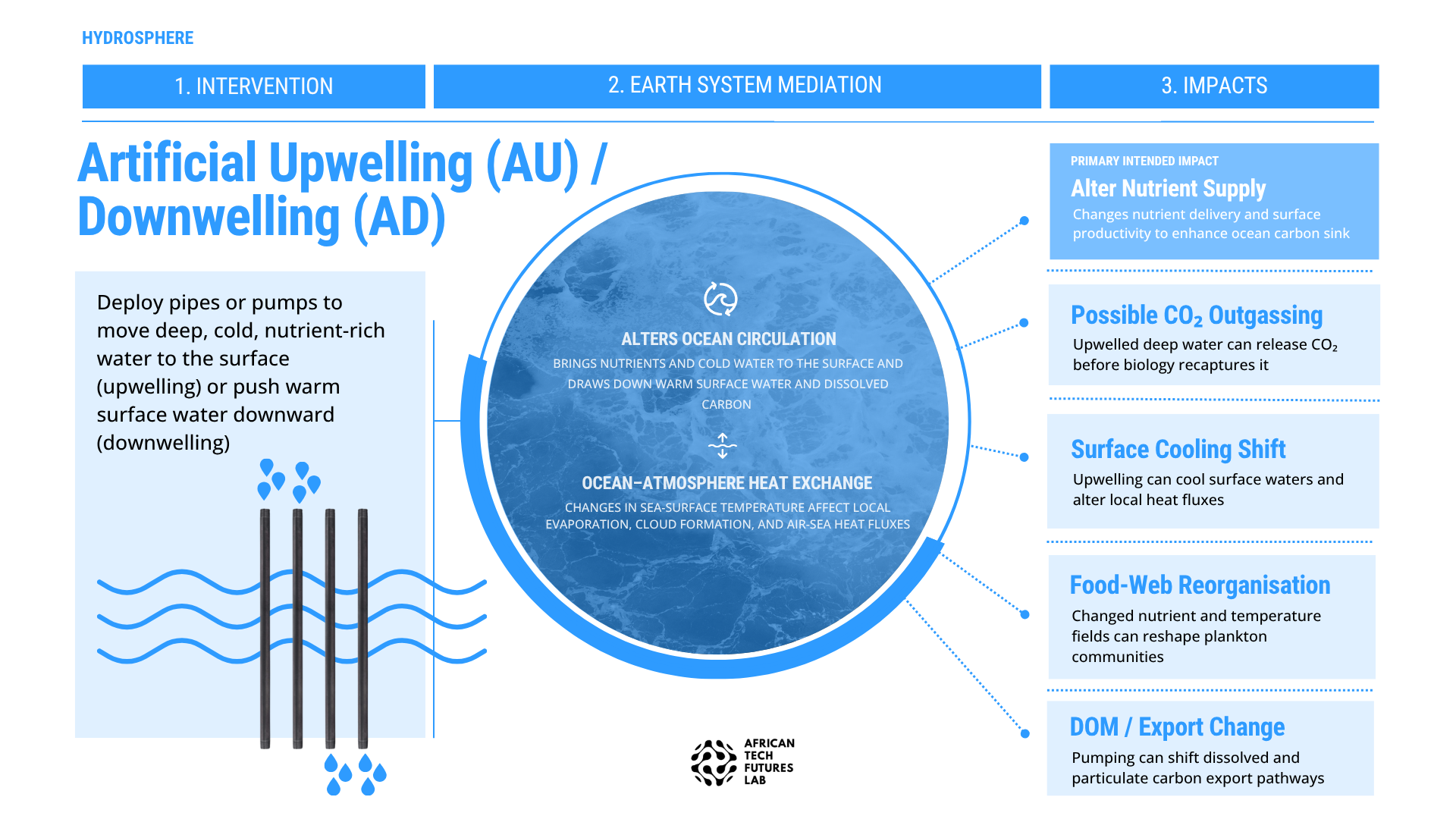
Artificial Upwelling (AU) / Downwelling (AD).
This climate intervention technique works by deploying pipes or pumps to move deep, cold, nutrient-rich water to the surface (upwelling) or push warm surface water downward (downwelling), and it would be mediated by the following key Earth systems: Alters Ocean Circulation and Ocean–Atmosphere Heat Exchange. A number of impacts and outcomes would be co-produced, including Alter Nutrient Supply, Possible CO₂ Outgassing, Surface Cooling Shift, Food-Web Reorganisation, and DOM / Export Change.
-
![]()
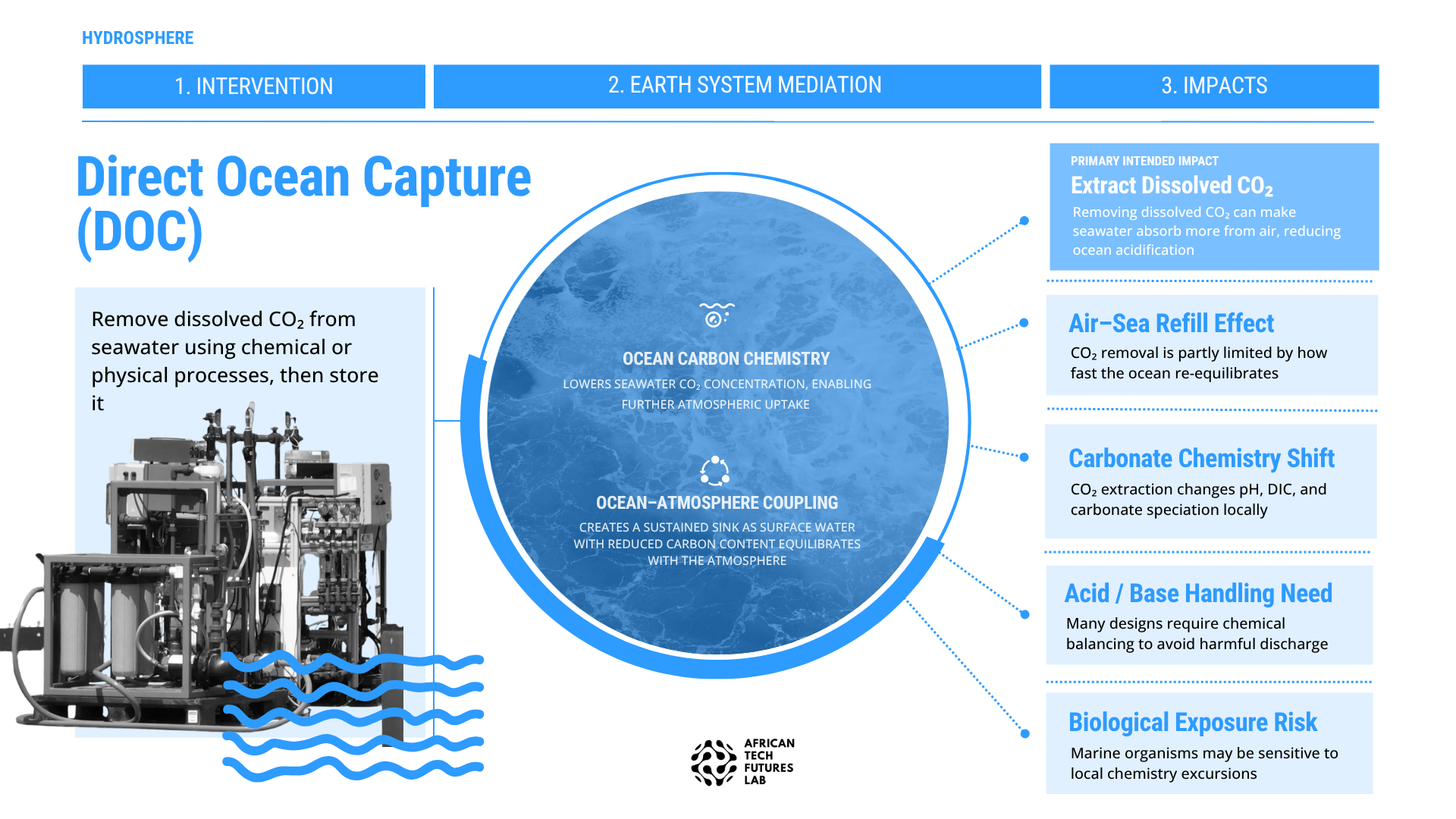
Direct Ocean Capture (DOC)
This climate intervention technique works by removing dissolved CO₂ from seawater using chemical or physical processes, then store it, and it would be mediated by the following key Earth systems: Ocean Carbon Chemistry and Ocean–Atmosphere Coupling. A number of impacts and outcomes would be co-produced, including Extract Dissolved CO₂, Air–Sea Refill Effect, Carbonate Chemistry Shift, Acid / Base Handling Need, and Biological Exposure Risk.
-
![]()
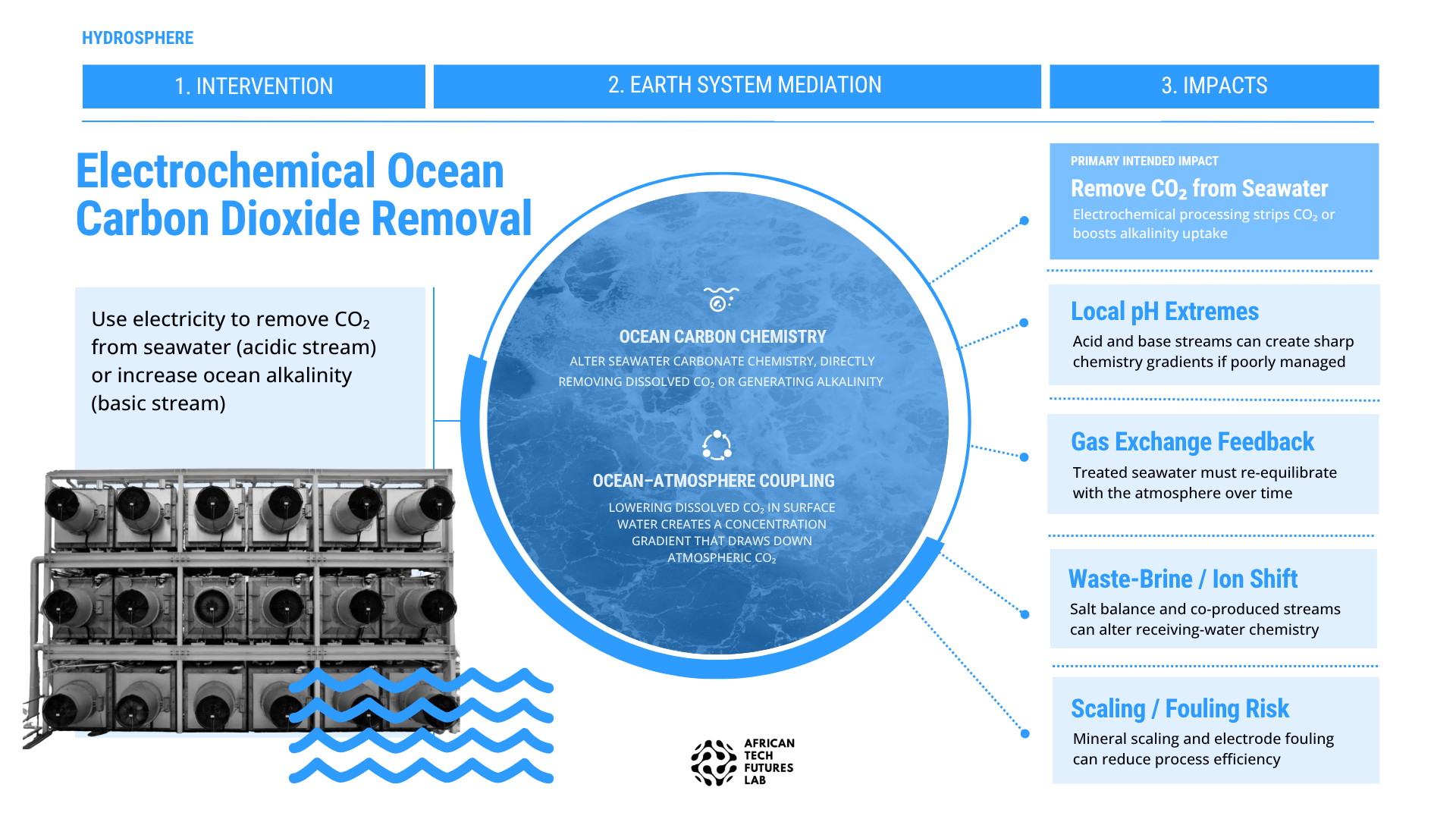
Electrochemical Ocean CDR
This climate intervention technique works by using electricity to remove CO₂ from seawater (acidic stream) or increase ocean alkalinity (basic stream), and it would be mediated by the following key Earth systems: Ocean Carbon Chemistry and Ocean–Atmosphere Coupling. A number of impacts and outcomes would be co-produced, including Remove CO₂ from Seawater, Local pH Extremes, Gas Exchange Feedback, Waste-Brine / Ion Shift, and Scaling / Fouling Risk.
-
![]()
Engineered re-oxygenation of eutrophic seas / ‘hypoxic basins’
This climate intervention technique works by injecting oxygenated water or engineer deep-water oxygen supply to hypoxic marine basins to alter benthic biogeochemistry, and it would be mediated by the following key Earth systems: Ocean Biogeochemistry. A number of impacts and outcomes would be co-produced, including Reduce Deep-Water Hypoxia, Redox / Nutrient Shift, Benthic Community Reset, Reduced-Compound Oxidation, and Oxygen Debt Return.
-
![]()
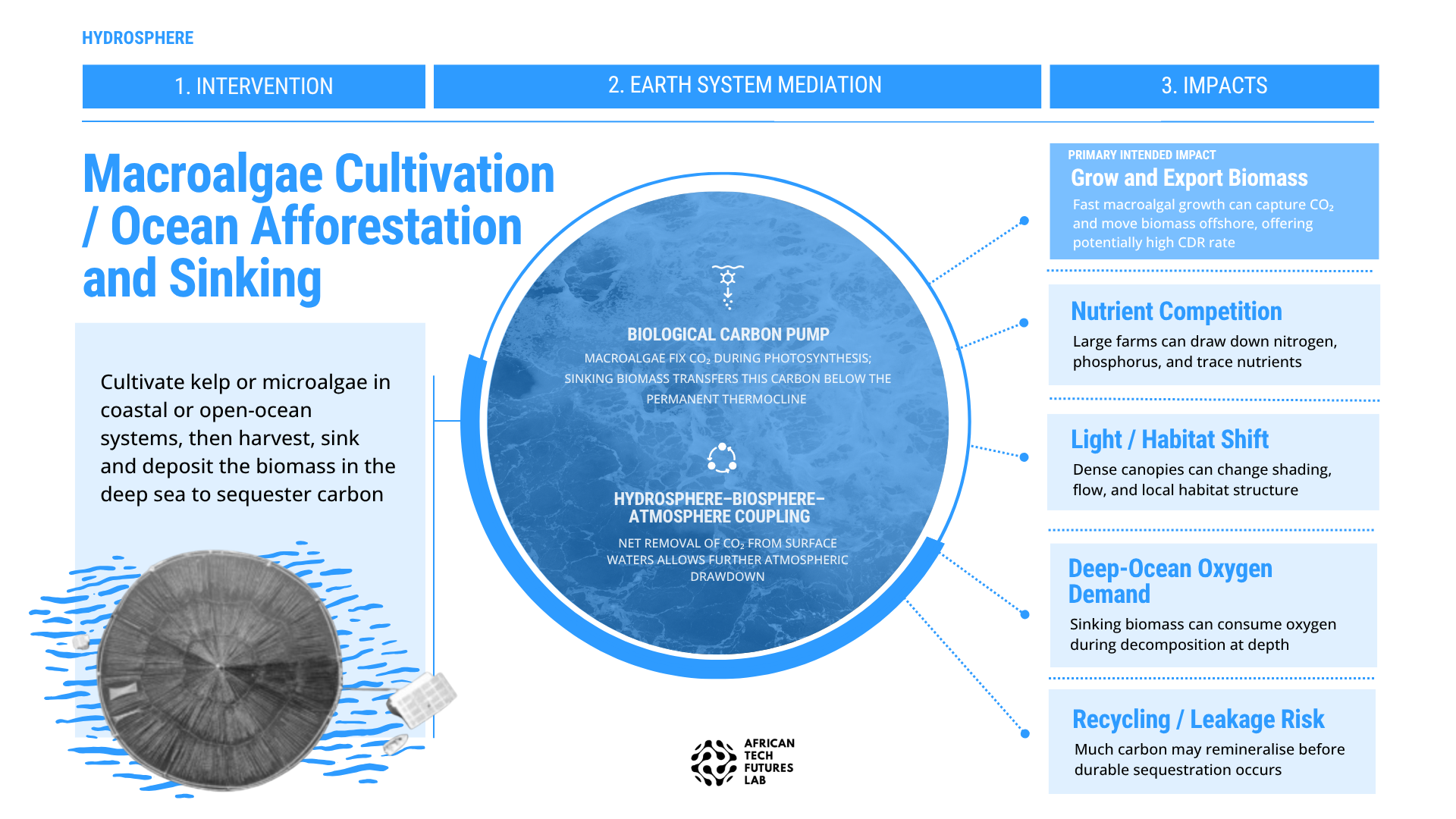
Macroalgae Cultivation / Ocean Afforestation and Sinking
This climate intervention technique works by cultivating kelp or microalgae in coastal or open-ocean systems, then harvest, sink and deposit the biomass in the deep sea to sequester, and it would be mediated by the following key Earth systems: Biological Carbon Pump and Hydrosphere–Biosphere–Atmosphere Coupling. A number of impacts and outcomes would be co-produced, including Grow and Export Biomass, Nutrient Competition, Light / Habitat Shift, Deep-Ocean Oxygen Demand, and Recycling / Leakage Risk.
-
![]()
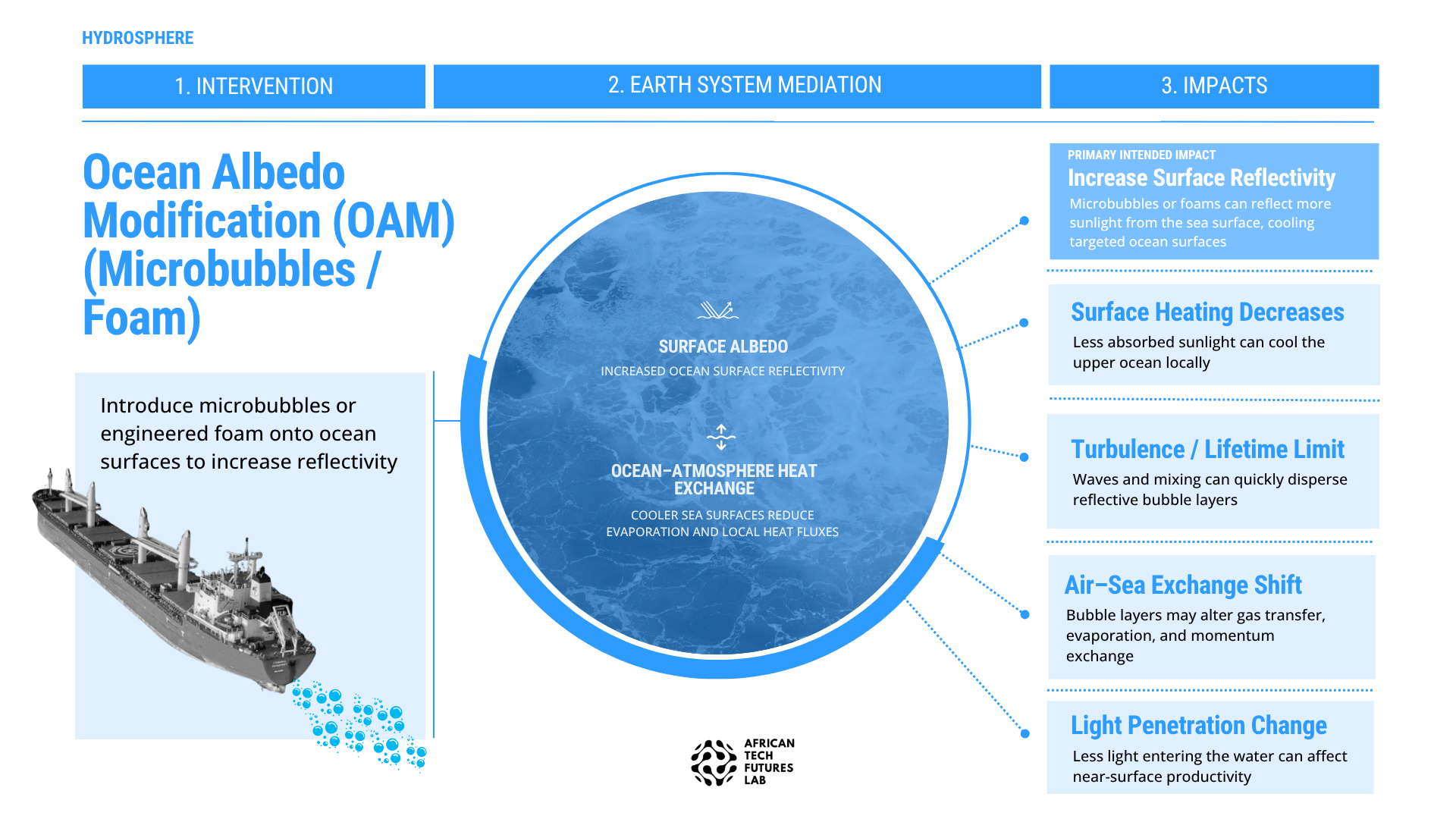
Ocean Albedo Modification (OAM) (microbubbles / foam)
This climate intervention technique works by introducing microbubbles or engineered foam onto ocean surfaces to increase reflectivity, and it would be mediated by the following key Earth systems: Surface Albedo and Ocean–Atmosphere Heat Exchange. A number of impacts and outcomes would be co-produced, including Increase Surface Reflectivity, Surface Heating Decreases, Turbulence / Lifetime Limit, Air–Sea Exchange Shift, and Light Penetration Change.
-
![]()
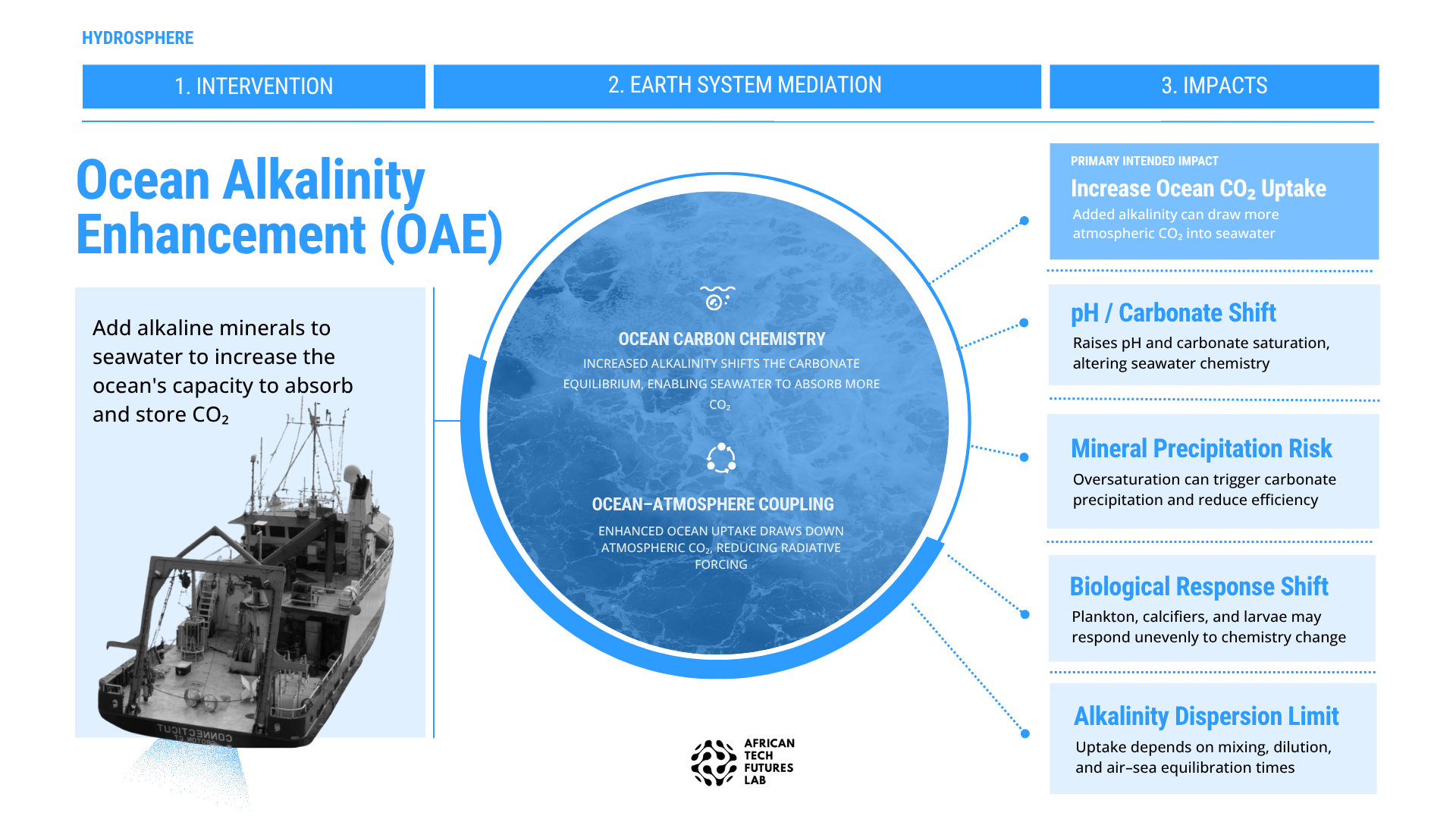
Ocean Alkalinity Enhancement (OAE)
This climate intervention technique works by adding alkaline minerals to seawater to increase the ocean's capacity to absorb and store CO₂, and it would be mediated by the following key Earth systems: Ocean Carbon Chemistry and Ocean–Atmosphere Coupling. A number of impacts and outcomes would be co-produced, including Increase Ocean CO₂ Uptake, pH / Carbonate Shift, Mineral Precipitation Risk, Biological Response Shift, and Alkalinity Dispersion Limit.
-
![]()
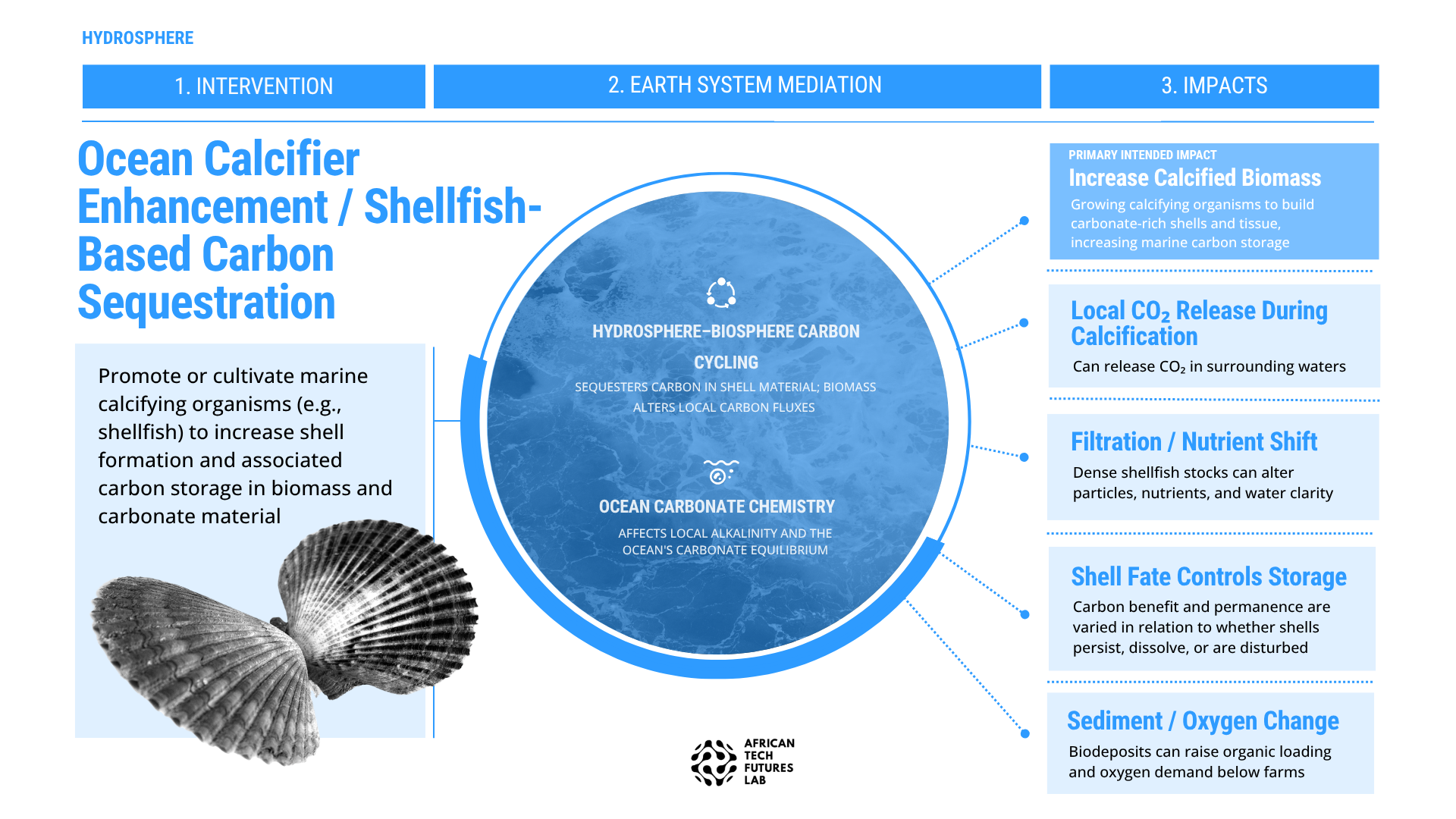
Ocean calcifier enhancement / shellfish-based carbon sequestration
This climate intervention technique works by promoting or cultivate marine calcifying organisms (e.g., shellfish) to increase shell formation and associated carbon storage in biomass and carbonate material, and it would be mediated by the following key Earth systems: Hydrosphere–Biosphere Carbon Cycling and Ocean Carbonate Chemistry. A number of impacts and outcomes would be co-produced, including Increase Calcified Biomass, Local CO₂ Release During Calcification, Filtration / Nutrient Shift, Shell Fate Controls Storage, and Sediment / Oxygen Change.
-
![]()
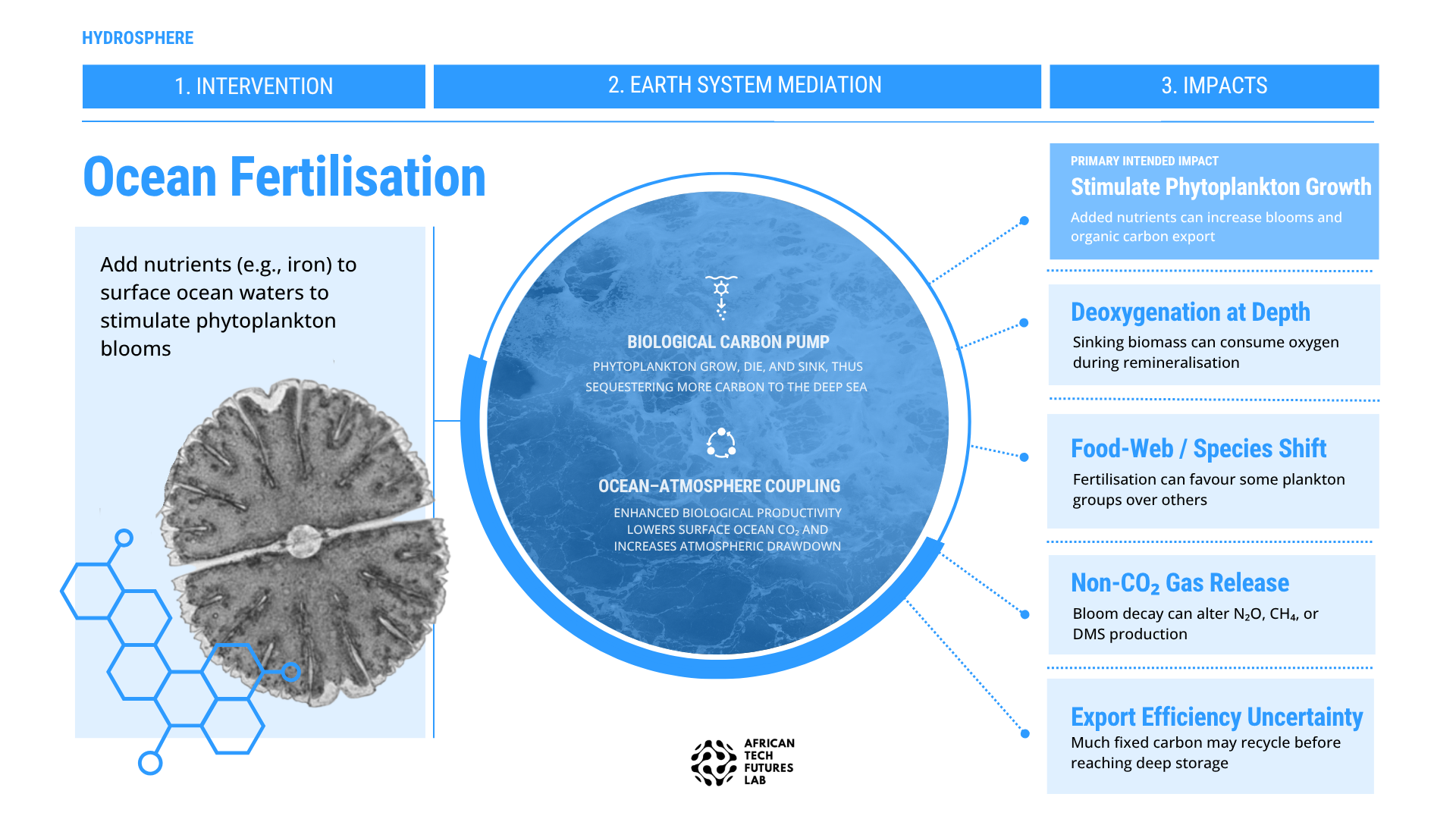
Ocean Fertilisation
This climate intervention technique works by adding nutrients (e.g., iron) to surface ocean waters to stimulate phytoplankton blooms, and it would be mediated by the following key Earth systems: Biological Carbon Pump and Ocean–Atmosphere Coupling. A number of impacts and outcomes would be co-produced, including Stimulate Phytoplankton Growth, Deoxygenation at Depth, Food-Web / Species Shift, Non-CO₂ Gas Release, and Export Efficiency Uncertainty.
-
![]()
Reservoir / Lake Methane Bubble Capture & Oxidation Systems
This climate intervention technique works by deploying floating covers/hoods, bubble collectors or degassing systems on freshwater reservoirs and lakes to capture methane, and it would be mediated by the following key Earth systems: Methane Interception and Hydrosphere–Atmosphere Coupling. A number of impacts and outcomes would be co-produced, including Intercept Methane Before Release, Hotspot Dependence, Water-Column Gas Shift, Oxygen / Redox Disturbance, and Storm / Mixing Vulnerability.
-
![]()
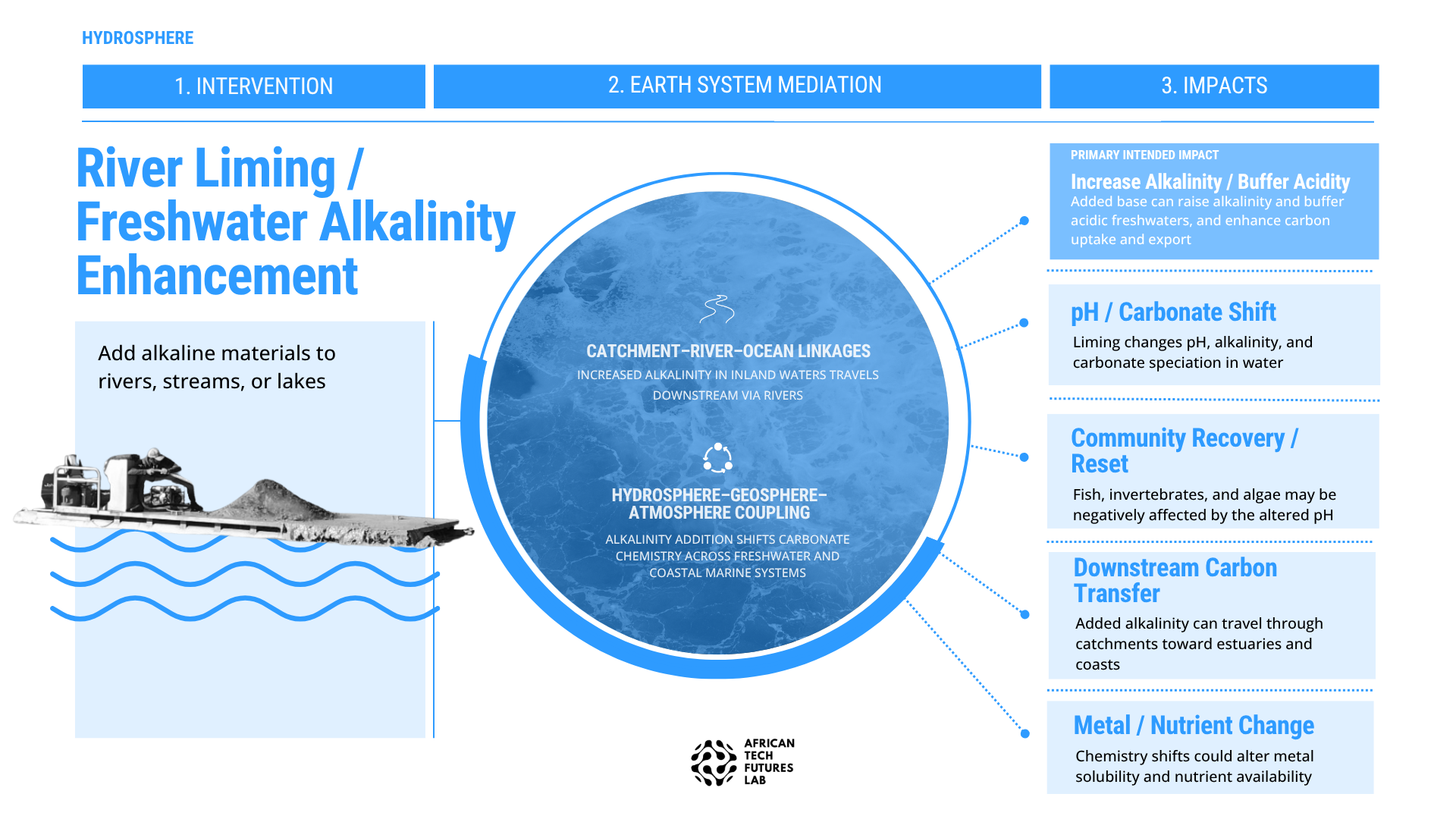
River liming / freshwater alkalinity enhancement
This climate intervention technique works by adding alkaline materials to rivers, streams, or lakes, and it would be mediated by the following key Earth systems: Catchment–River–Ocean Linkages and Hydrosphere–Geosphere–Atmosphere Coupling. A number of impacts and outcomes would be co-produced, including Increase Alkalinity / Buffer Acidity, pH / Carbonate Shift, Community Recovery / Reset, Downstream Carbon Transfer, and Metal / Nutrient Change.
-
![]()
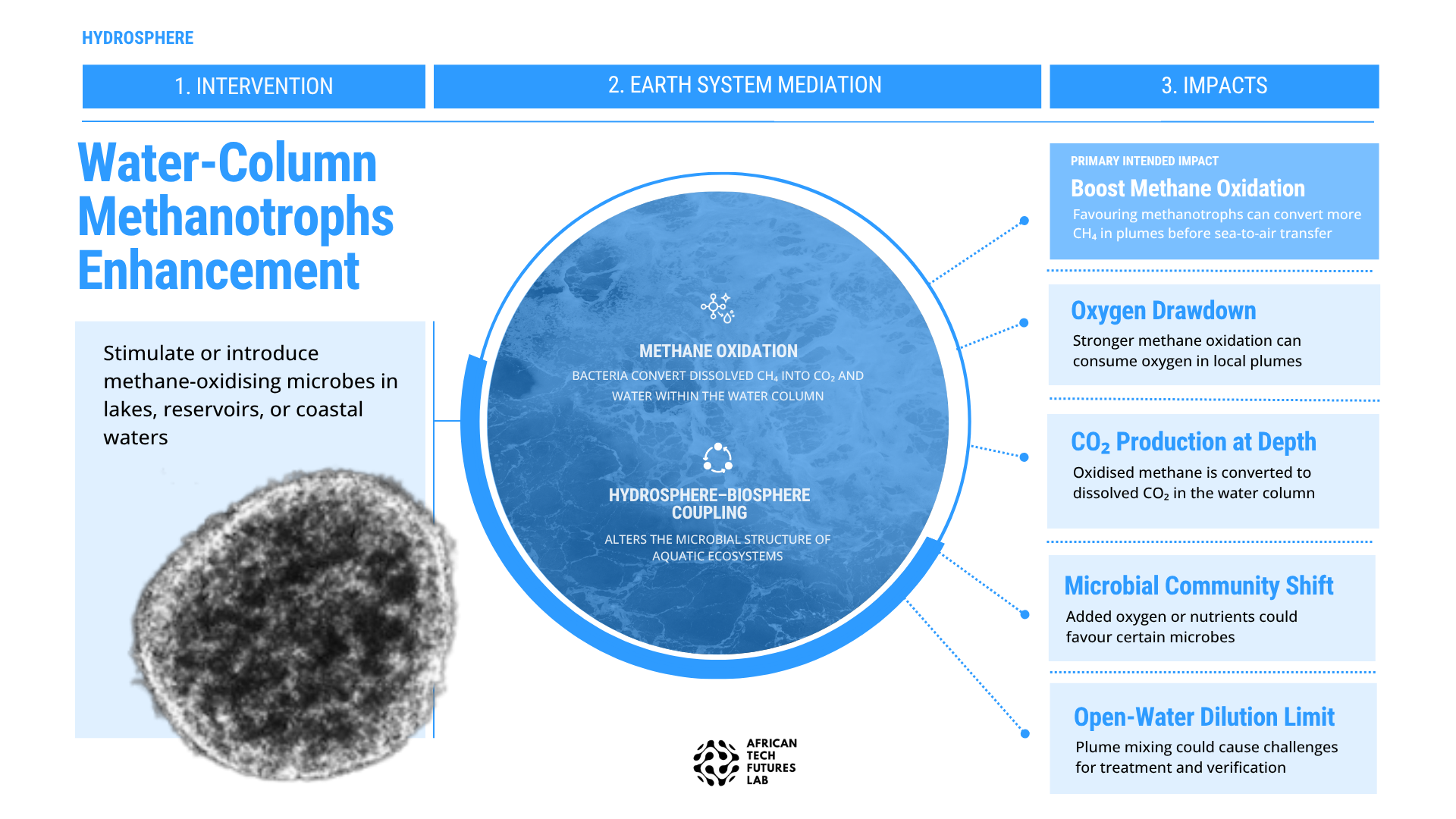
Water-column methanotrophs enhancement
This climate intervention technique works by stimulating or introduce methane-oxidising microbes in lakes, reservoirs, or coastal waters, and it would be mediated by the following key Earth systems: Methane Oxidation and Hydrosphere–Biosphere Coupling. A number of impacts and outcomes would be co-produced, including Boost Methane Oxidation, Oxygen Drawdown, CO₂ Production at Depth, Microbial Community Shift, and Open-Water Dilution Limit.


Previous
Previous
Atmosphere
Next
Next