
-
![]()
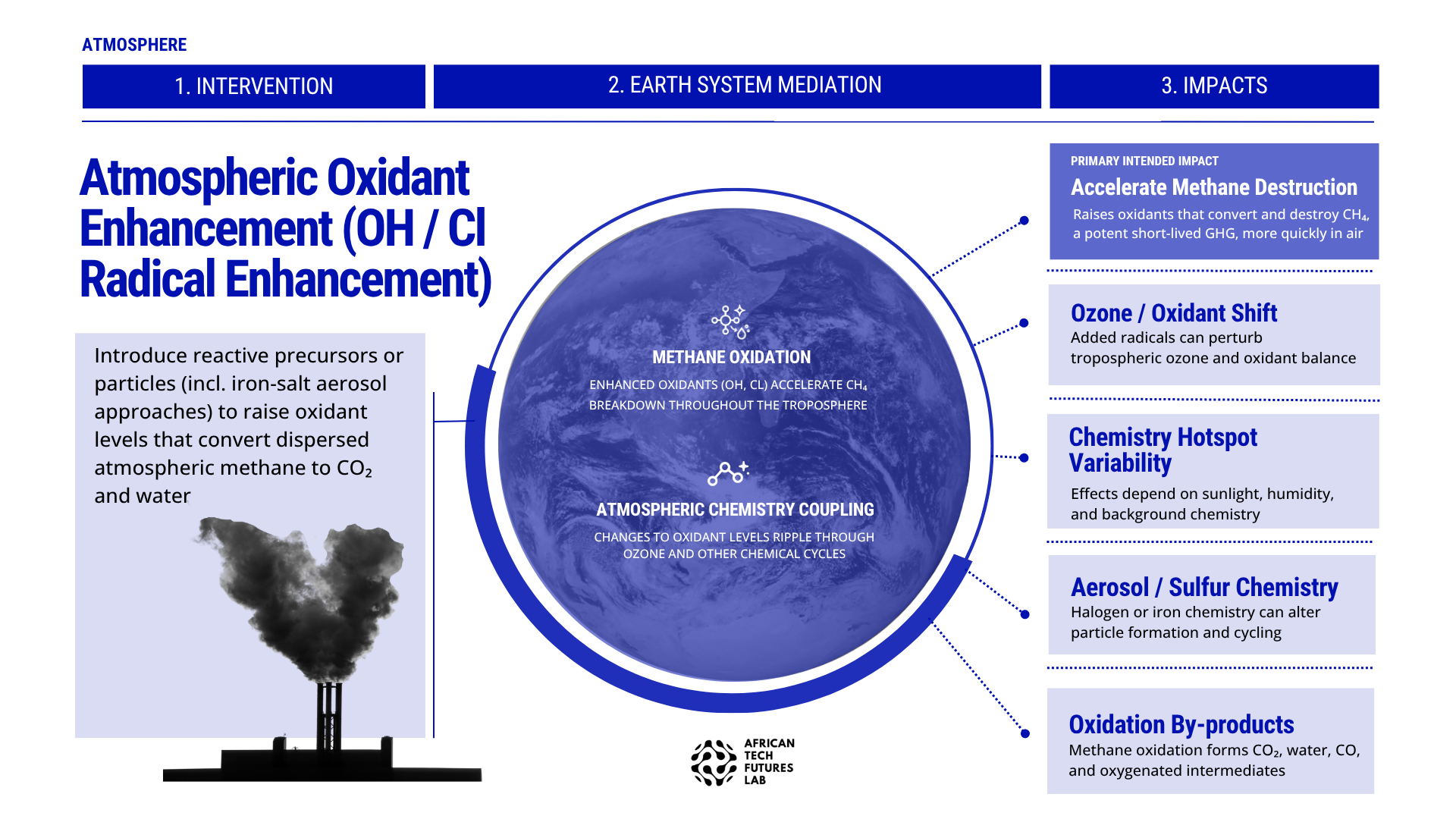
Atmospheric Oxidant Enhancement (OH / Cl radical enhancement)
This climate intervention technique works by introducing reactive precursors or particles (incl. iron-salt aerosol approaches) to raise oxidant levels that convert dispersed atmospheric methane to CO₂ and water, and it would be mediated by the following key Earth systems: Methane Oxidation and Atmospheric Chemistry Coupling. A number of impacts and outcomes would be co-produced, including Accelerate Methane Destruction, Ozone / Oxidant Shift, Chemistry Hotspot Variability, Aerosol / Sulfur Chemistry, and Oxidation By-products.
-
![]()
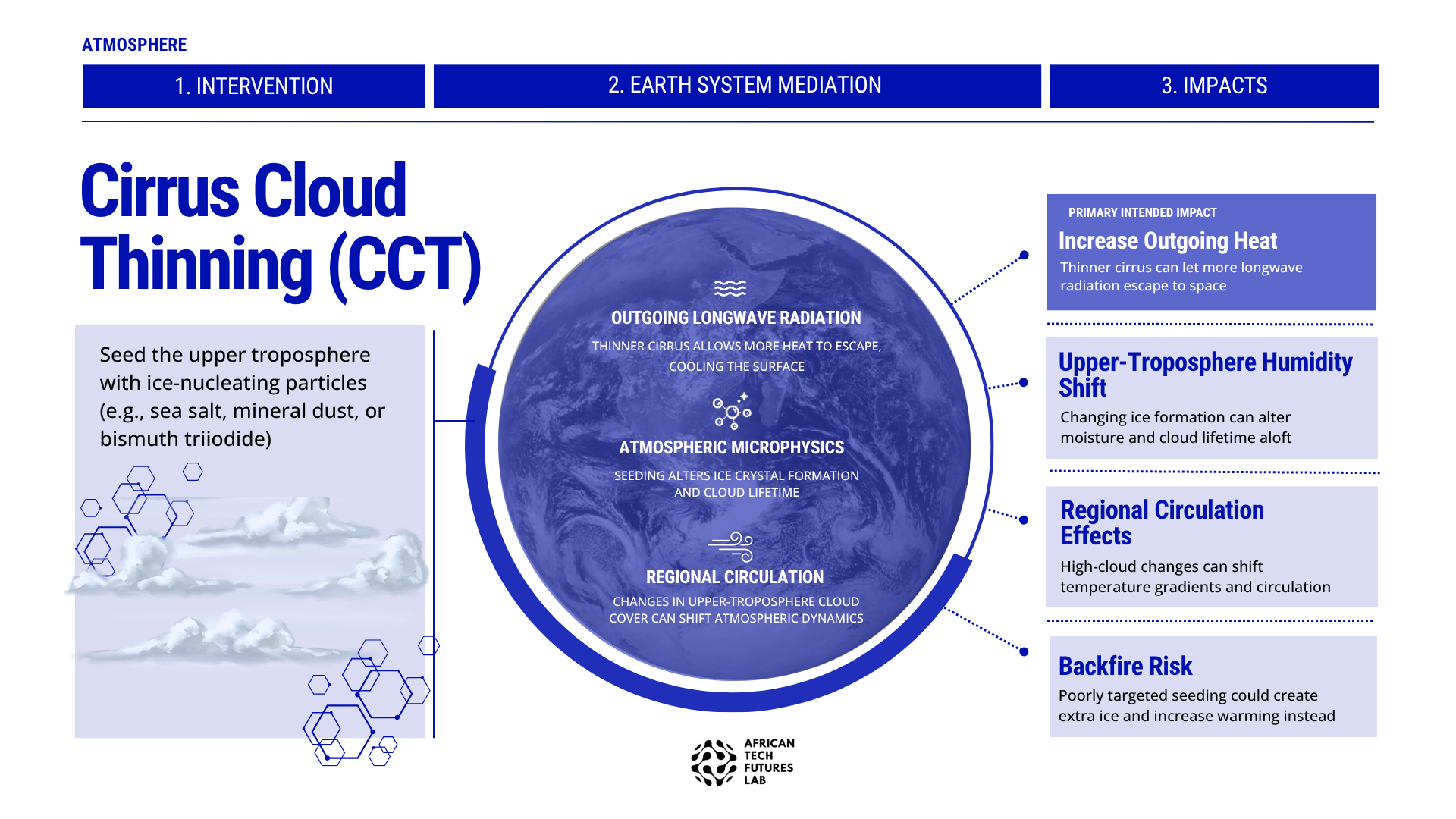
Cirrus Cloud Thinning (CCT)
This climate intervention technique works by seeding the upper troposphere with ice-nucleating particles (e.g., sea salt, mineral dust, or bismuth triiodide), and it would be mediated by the following key Earth systems: Outgoing Longwave Radiation, Atmospheric Microphysics, and Regional Circulation. A number of impacts and outcomes would be co-produced, including Increase Outgoing Heat, Upper-Troposphere Humidity Shift, Regional Circulation Effects, and Backfire Risk.
-
![]()
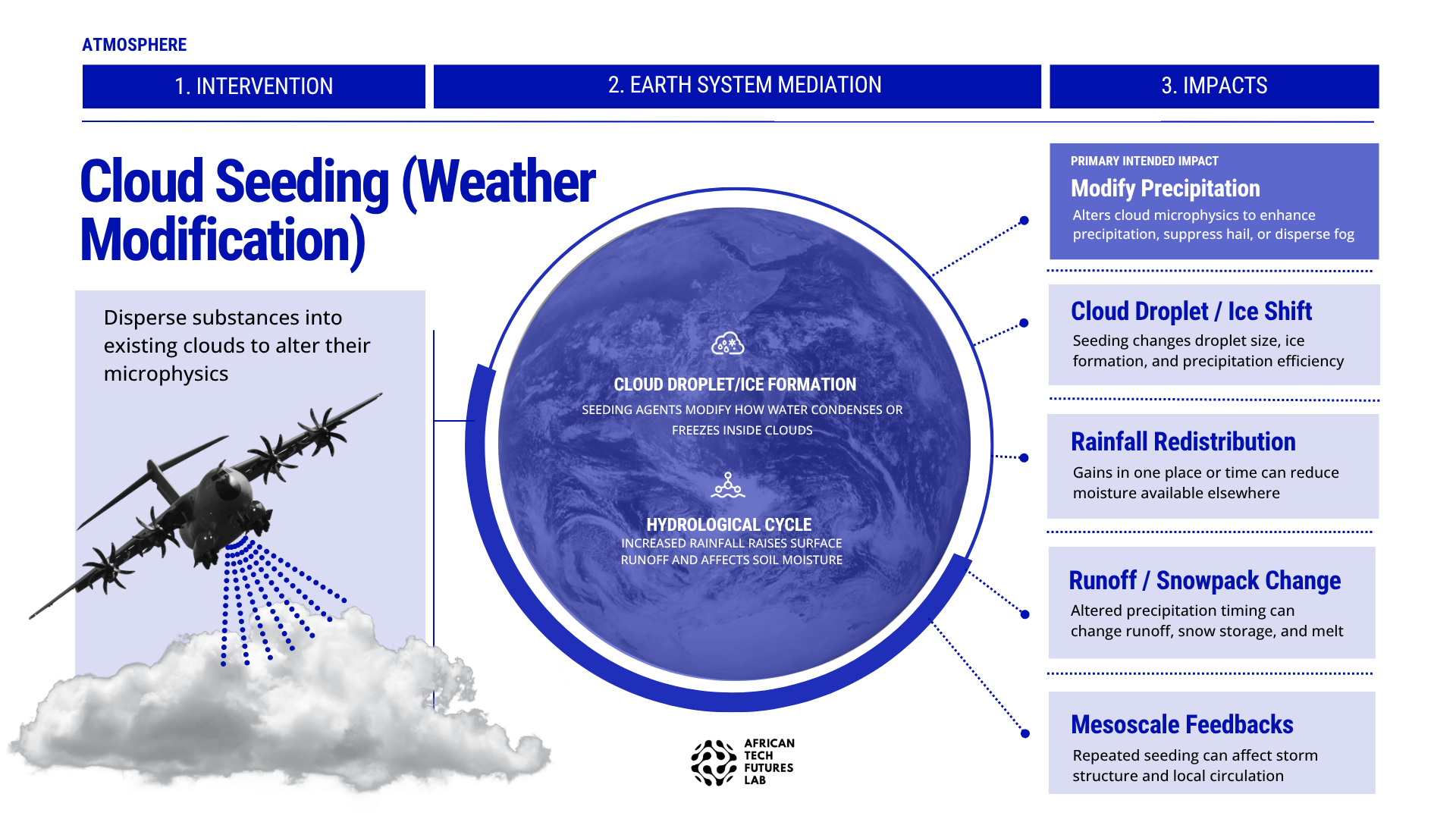
Cloud Seeding (weather modification)
This climate intervention technique works by dispersing substances into existing clouds to alter their microphysics, and it would be mediated by the following key Earth systems: Cloud Droplet/Ice Formation and Hydrological Cycle. A number of impacts and outcomes would be co-produced, including Modify Precipitation, Cloud Droplet / Ice Shift, Rainfall Redistribution, Runoff / Snowpack Change, and Mesoscale Feedbacks.
-
![]()
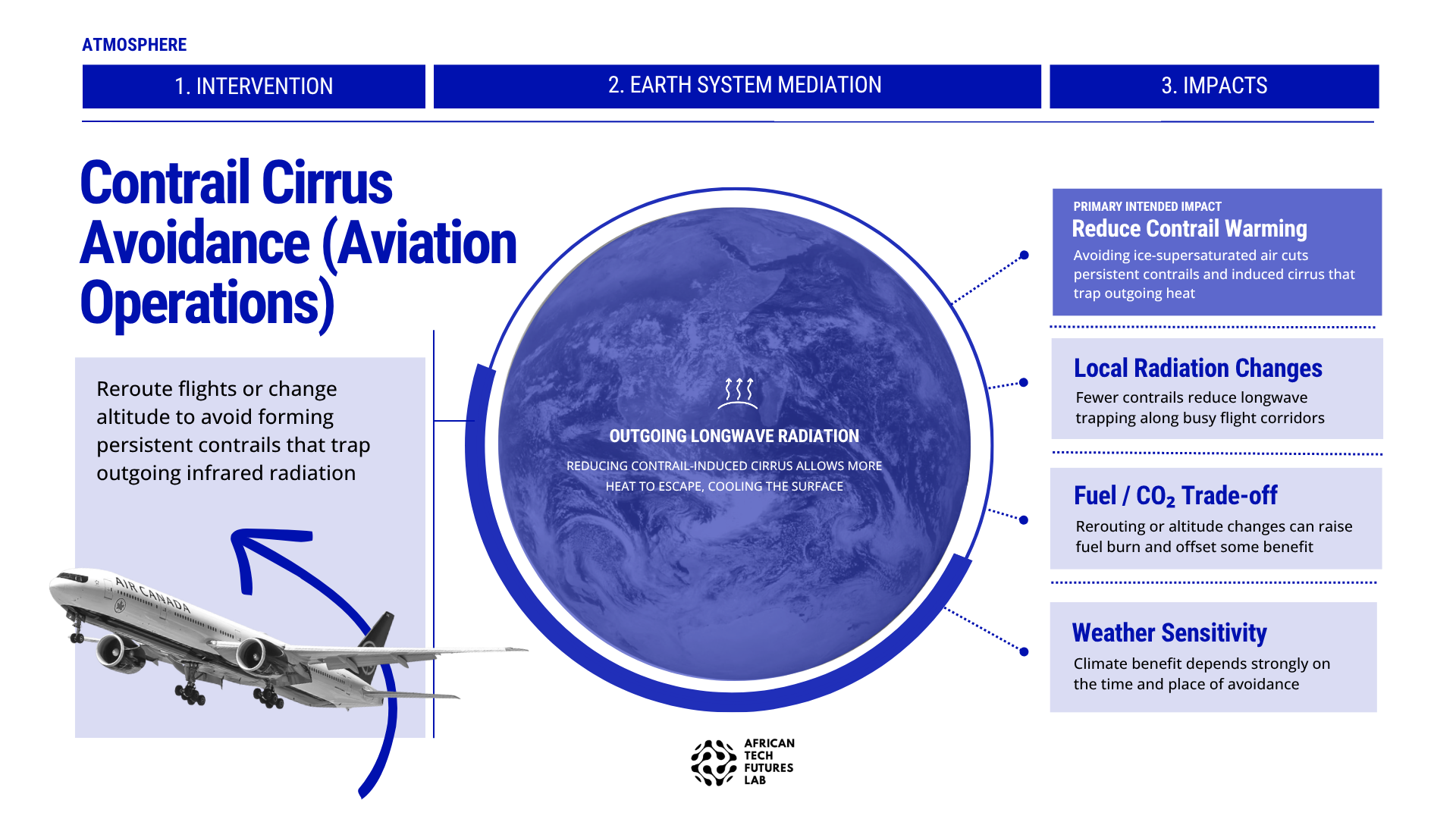
Contrail Cirrus Avoidance (aviation operations)
This climate intervention technique works by rerouting flights or changing altitude to avoid forming persistent contrails that trap outgoing infrared radiation, and it would be mediated by the following key Earth systems: Outgoing Longwave Radiation. A number of impacts and outcomes would be co-produced, including Reduce Contrail Warming, Local Radiation Changes, Fuel / CO₂ Trade-off, and Weather Sensitivity.
-
![]()
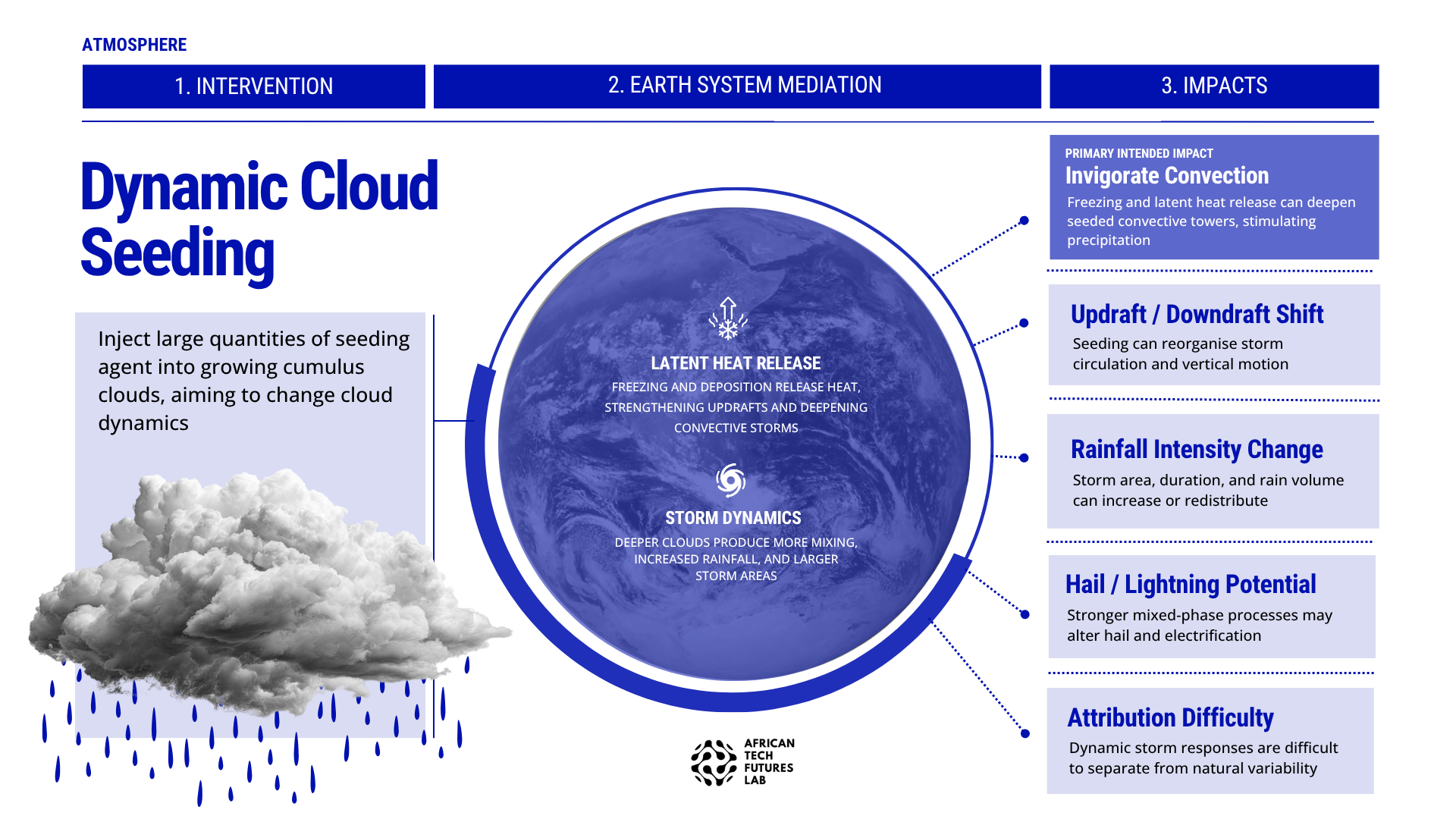
Dynamic Cloud Seeding
This climate intervention technique works by injecting large quantities of seeding agent into growing cumulus clouds, aiming to change cloud dynamics, and it would be mediated by the following key Earth systems: Latent Heat Release and Storm Dynamics. A number of impacts and outcomes would be co-produced, including Invigorate Convection, Updraft / Downdraft Shift, Rainfall Intensity Change, Hail / Lightning Potential, and Attribution Difficulty.
-
![]()
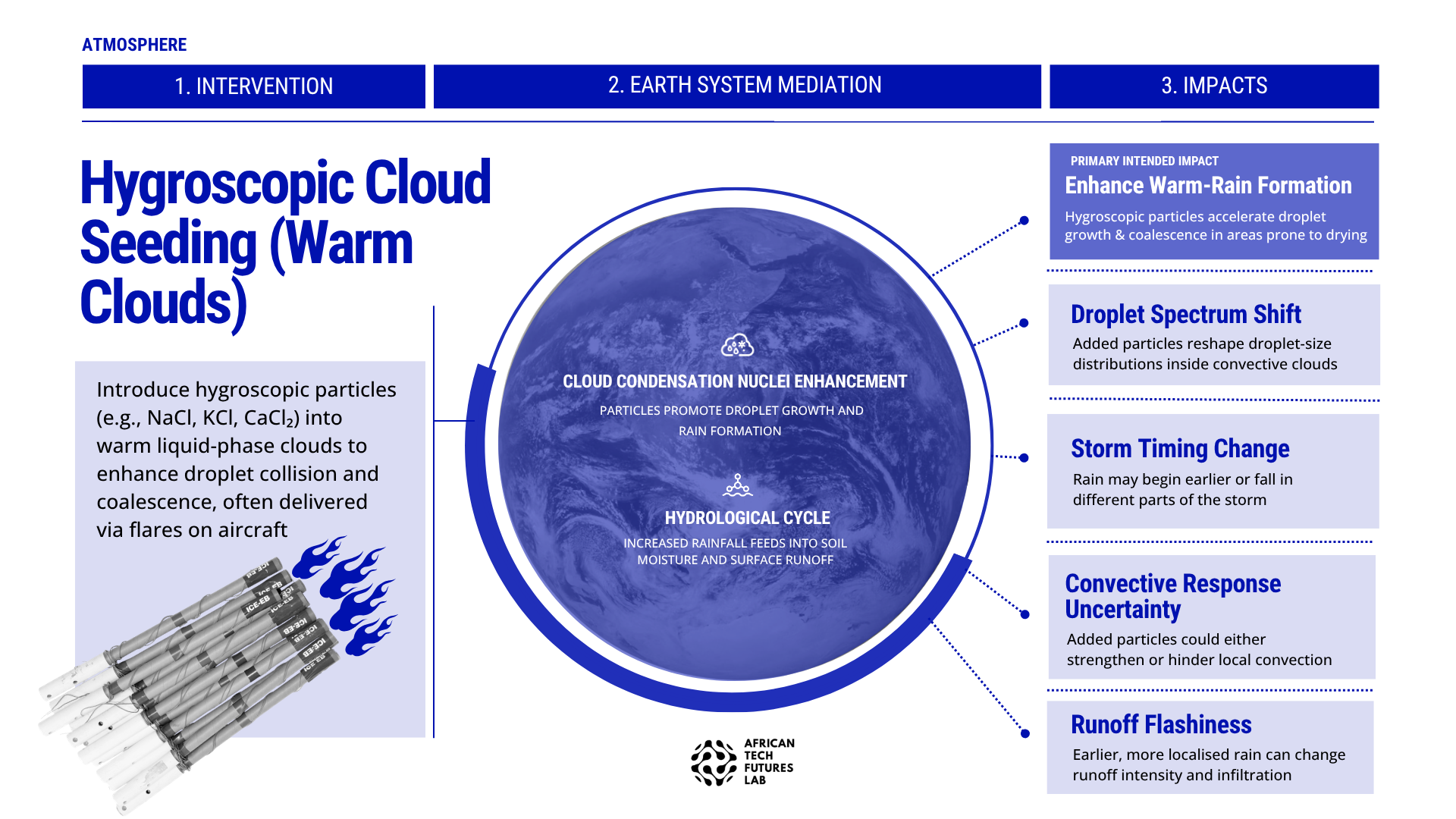
Hygroscopic Cloud Seeding (warm clouds)
This climate intervention technique works by introducing hygroscopic particles (e.g., NaCl, KCl, CaCl₂) into warm liquid-phase clouds to enhance droplet collision and coalescence, often delivered via flares on aircraft, and it would be mediated by the following key Earth systems: Cloud Condensation Nuclei Enhancement and Hydrological Cycle. A number of impacts and outcomes would be co-produced, including Enhance Warm-Rain Formation, Droplet Spectrum Shift, Storm Timing Change, Convective Response Uncertainty, and Runoff Flashiness.
-
![]()
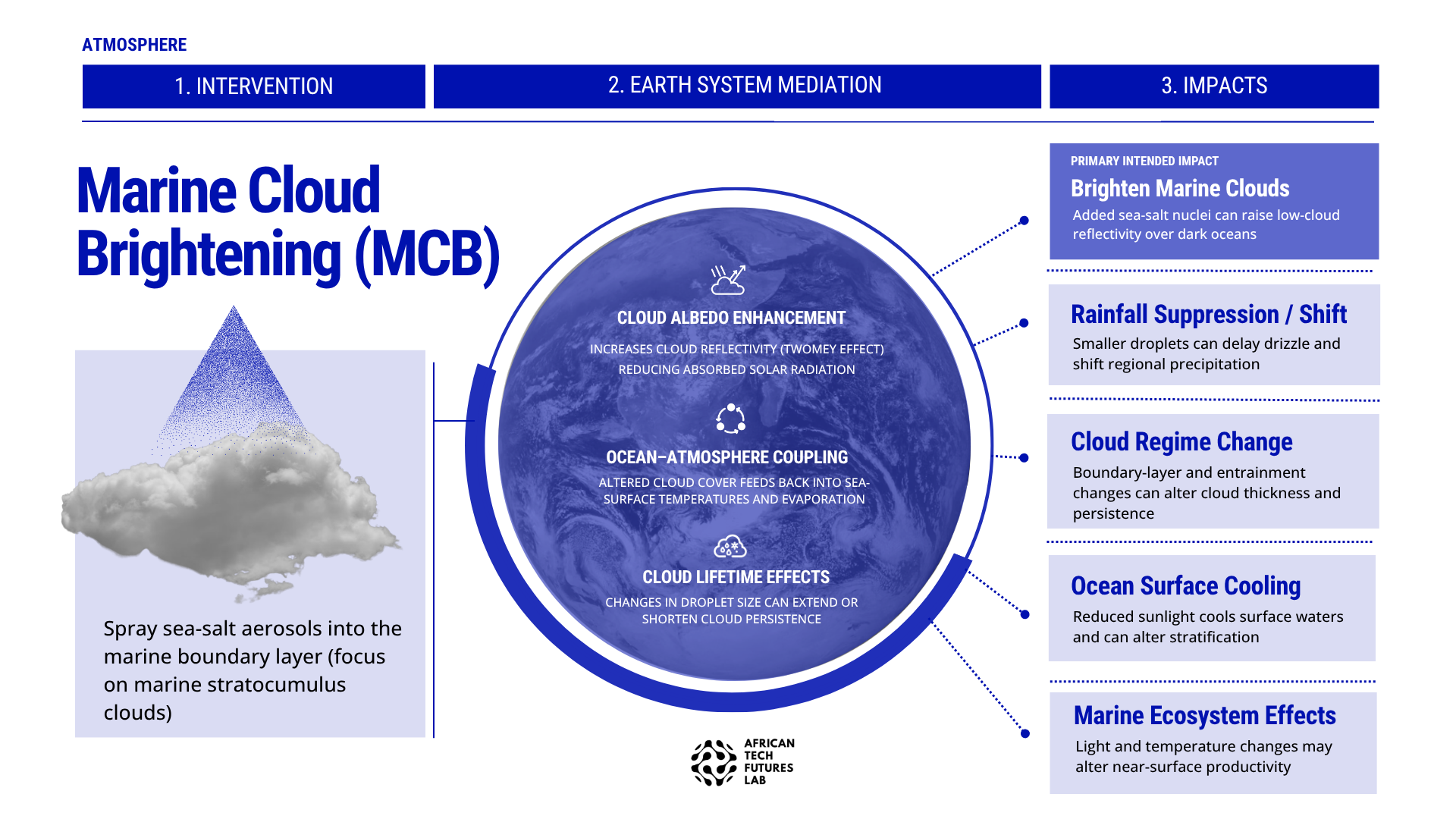
Marine Cloud Brightening (MCB)
This climate intervention technique works by spraying sea-salt aerosols into the marine boundary layer (focus on marine stratocumulus clouds), and it would be mediated by the following key Earth systems: Cloud Albedo Enhancement, Ocean–Atmosphere Coupling, and Cloud Lifetime Effects. A number of impacts and outcomes would be co-produced, including Brighten Marine Clouds, Rainfall Suppression / Shift, Cloud Regime Change, Ocean Surface Cooling, and Marine Ecosystem Effects.
-
![]()
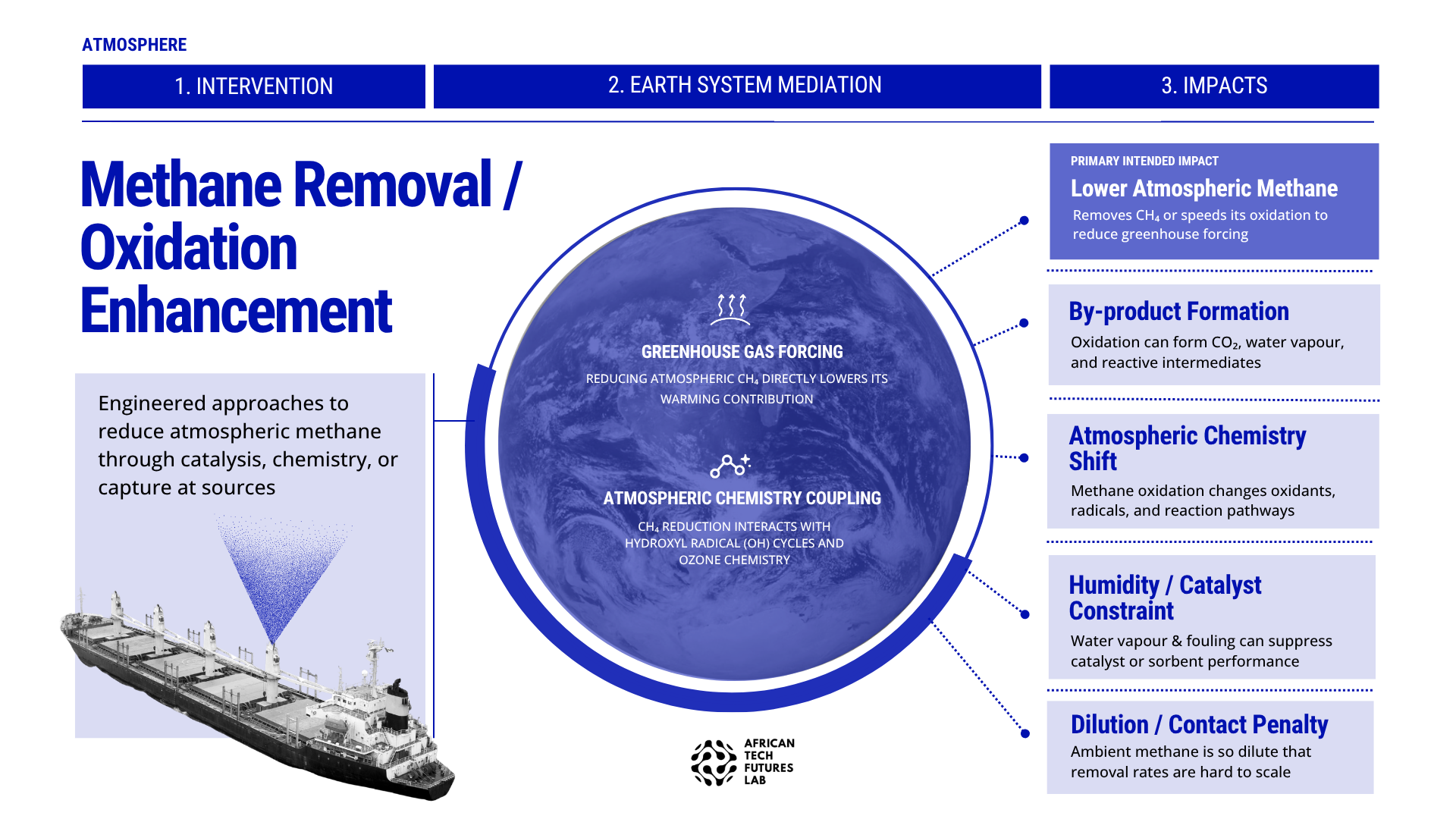
Methane Removal / Oxidation Enhancement
This climate intervention technique works by using engineered approaches to reduce atmospheric methane through catalysis, chemistry, or capture at sources, and it would be mediated by the following key Earth systems: Greenhouse Gas Forcing and Atmospheric Chemistry Coupling. A number of impacts and outcomes would be co-produced, including Lower Atmospheric Methane, By-product Formation, Atmospheric Chemistry Shift, Humidity / Catalyst Constraint, and Dilution / Contact Penalty.
-
![]()
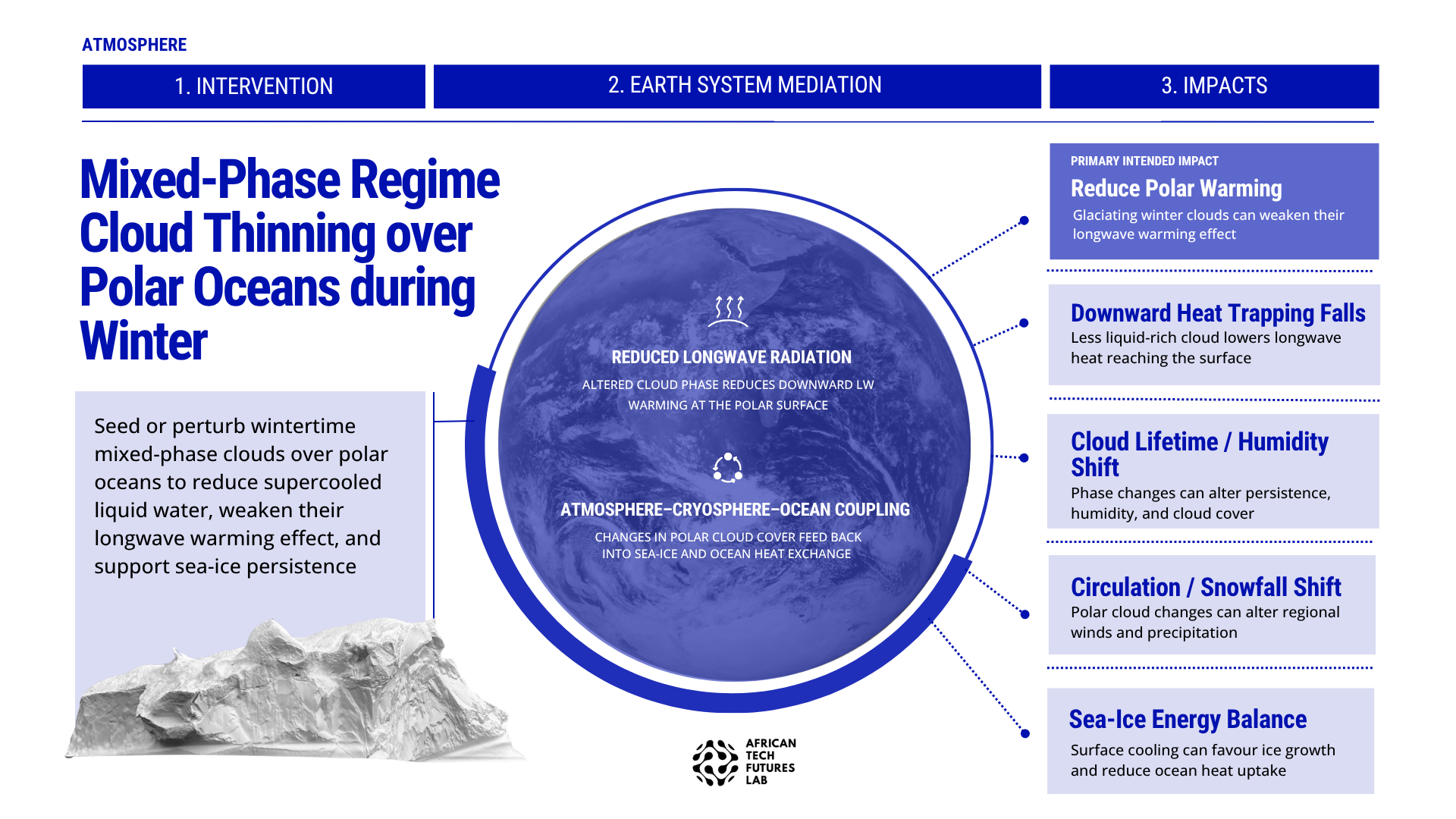
Mixed-phase Regime Cloud Thinning Over Polar Oceans During Winter
This climate intervention technique works by seeding or perturb wintertime mixed-phase clouds over polar oceans to reduce supercooled liquid water, weaken their longwave warming effect, and support sea-ice persistence, and it would be mediated by the following key Earth systems: Reduced Longwave Radiation and Atmosphere–Cryosphere–Ocean Coupling. A number of impacts and outcomes would be co-produced, including Reduce Polar Warming, Downward Heat Trapping Falls, Cloud Lifetime / Humidity Shift, Circulation / Snowfall Shift, and Sea-Ice Energy Balance.
-
![]()
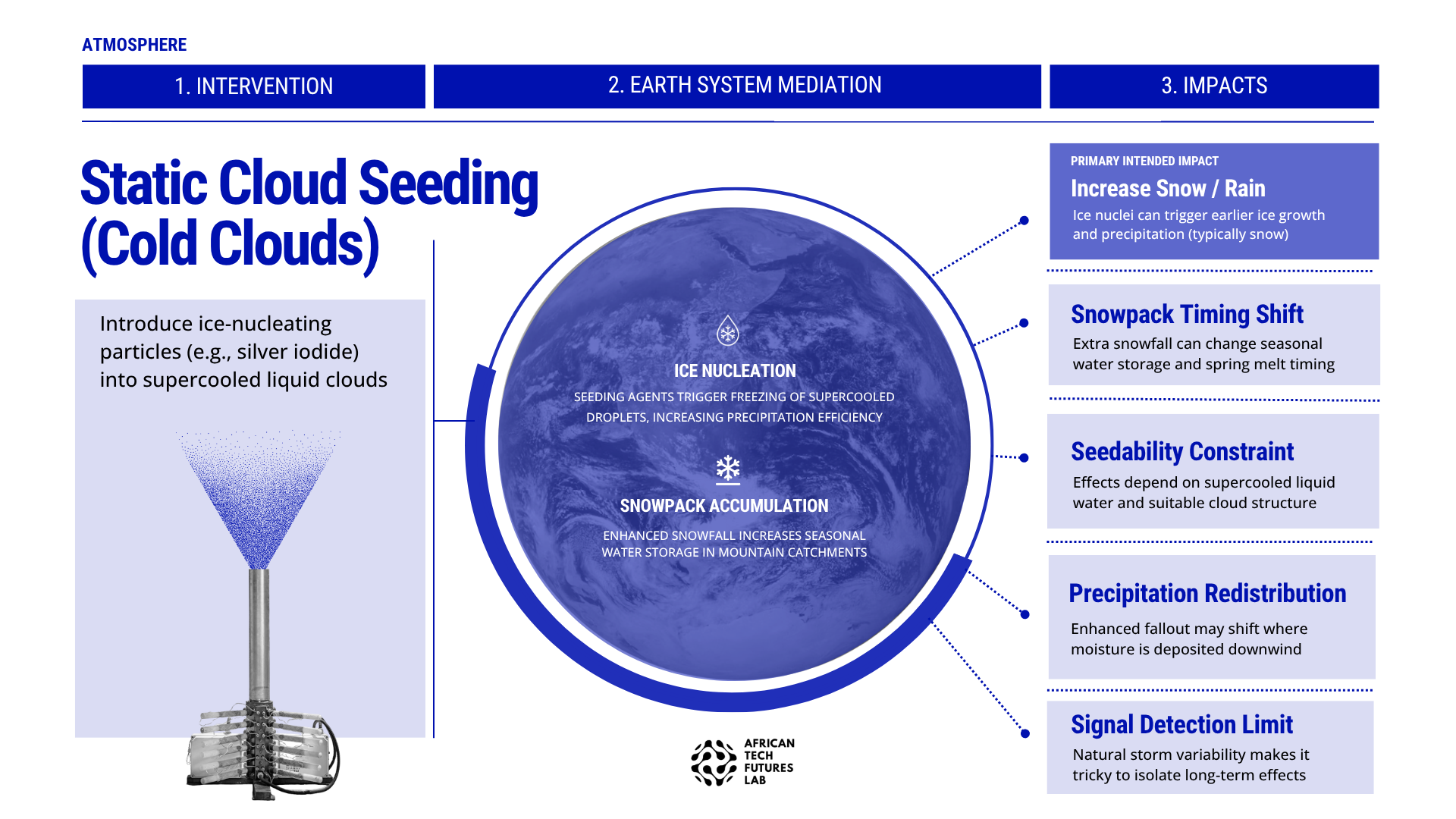
Static Cloud Seeding (cold clouds)
This climate intervention technique works by introducing ice-nucleating particles (e.g., silver iodide) into supercooled liquid clouds, and it would be mediated by the following key Earth systems: Ice Nucleation and Snowpack Accumulation. A number of impacts and outcomes would be co-produced, including Increase Snow / Rain, Snowpack Timing Shift, Seedability Constraint, Precipitation Redistribution, and Signal Detection Limit.
-
![]()
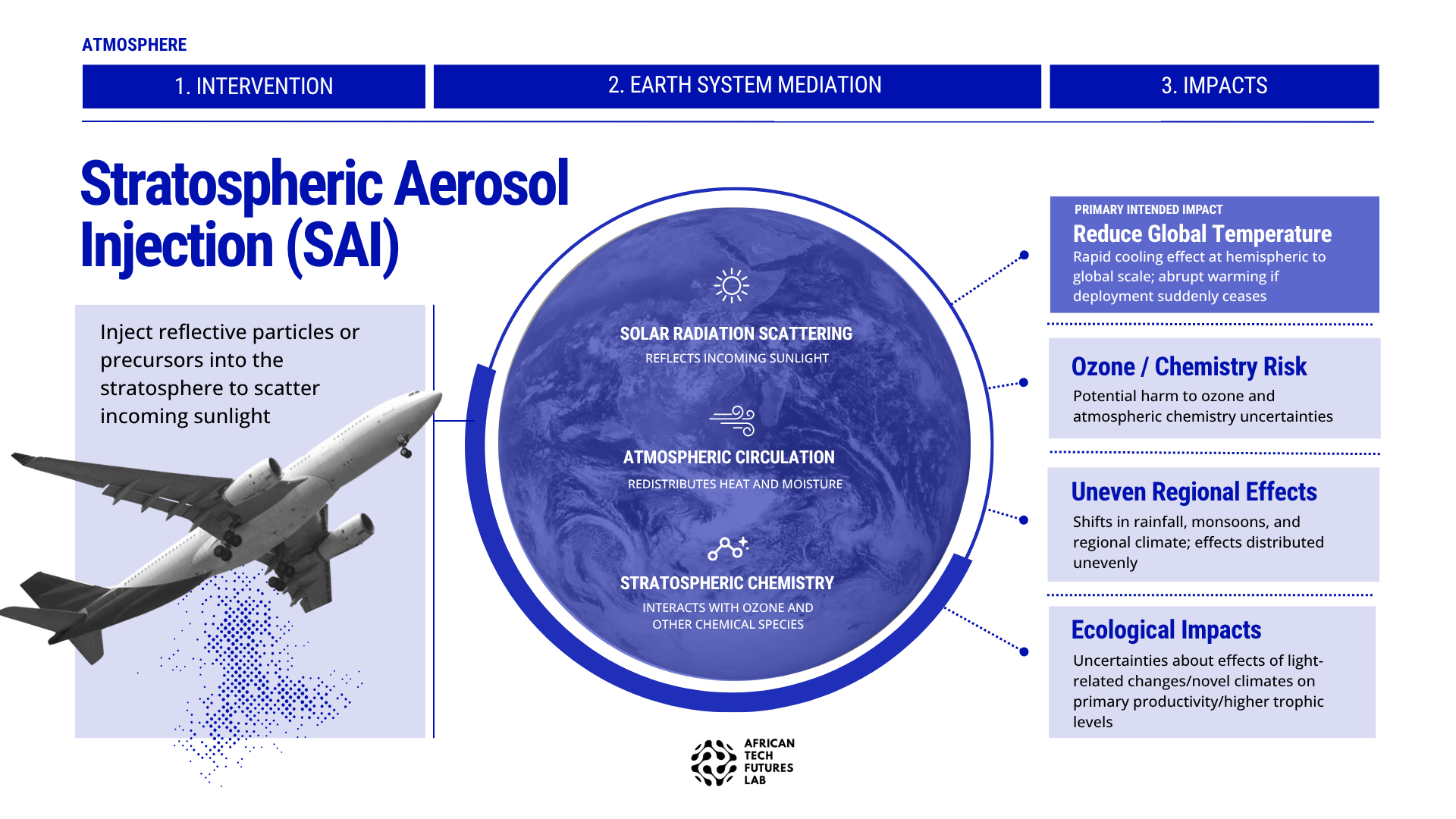
Stratospheric Aerosol Injection (SAI)
This climate intervention technique works by injecting reflective particles or precursors into the stratosphere to scatter incoming sunlight, and it would be mediated by the following key Earth systems: Solar Radiation Scattering, Atmospheric Circulation, and Stratospheric Chemistry. A number of impacts and outcomes would be co-produced, including Reduce Global Temperature, Ozone / Chemistry Risk, Uneven Regional Effects, and Ecological Impacts.
-
![]()
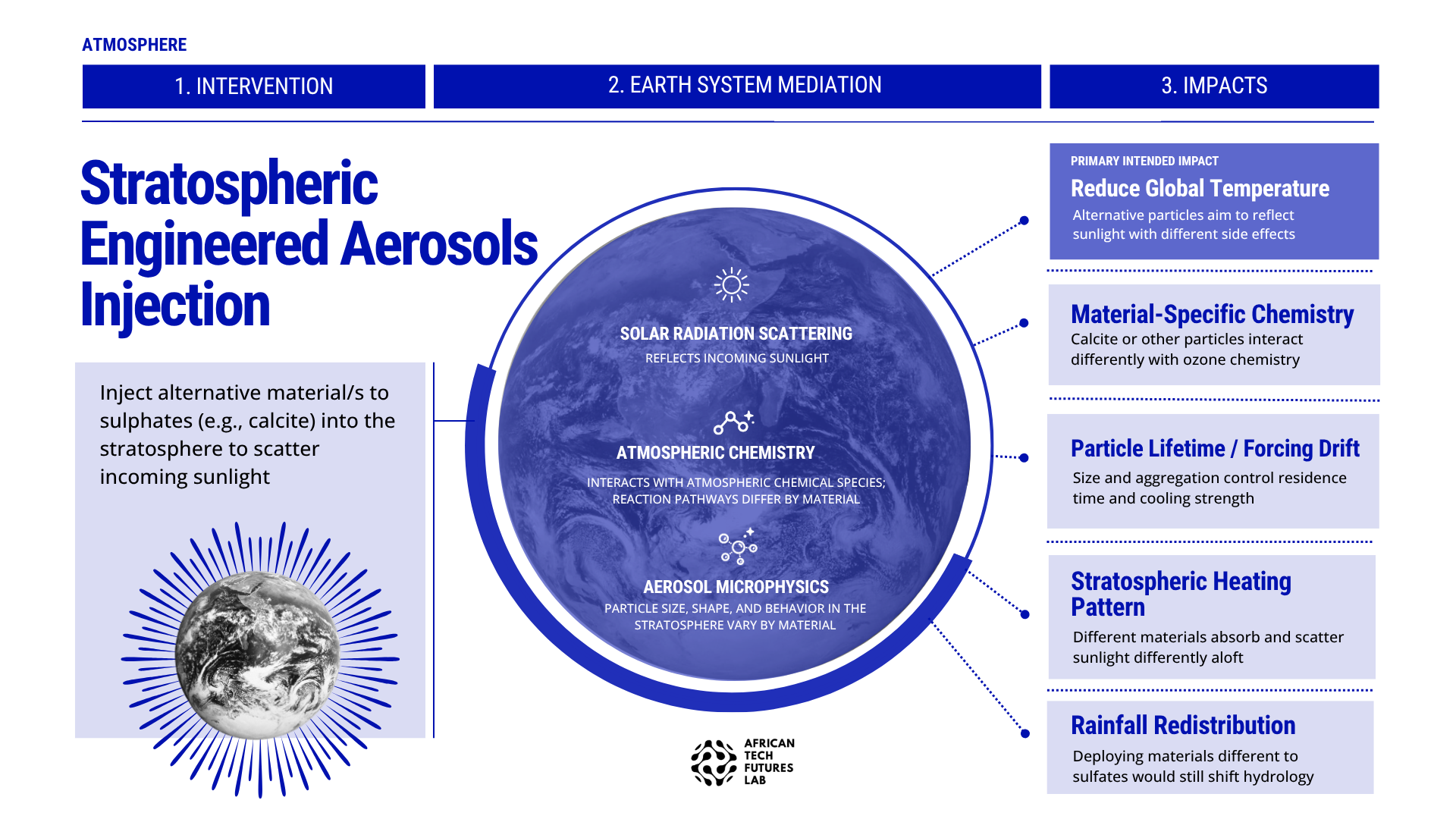
Stratospheric Engineered Aerosols Injection
This climate intervention technique works by injecting alternative material/s to sulphates (e.g., calcite) into the stratosphere to scatter incoming sunlight, and it would be mediated by the following key Earth systems: Solar Radiation Scattering, Atmospheric Chemistry, and Aerosol Microphysics. A number of impacts and outcomes would be co-produced, including Reduce Global Temperature, Material-Specific Chemistry, Particle Lifetime / Forcing Drift, Stratospheric Heating Pattern, and Rainfall Redistribution.
Next
Next