
-
![]()
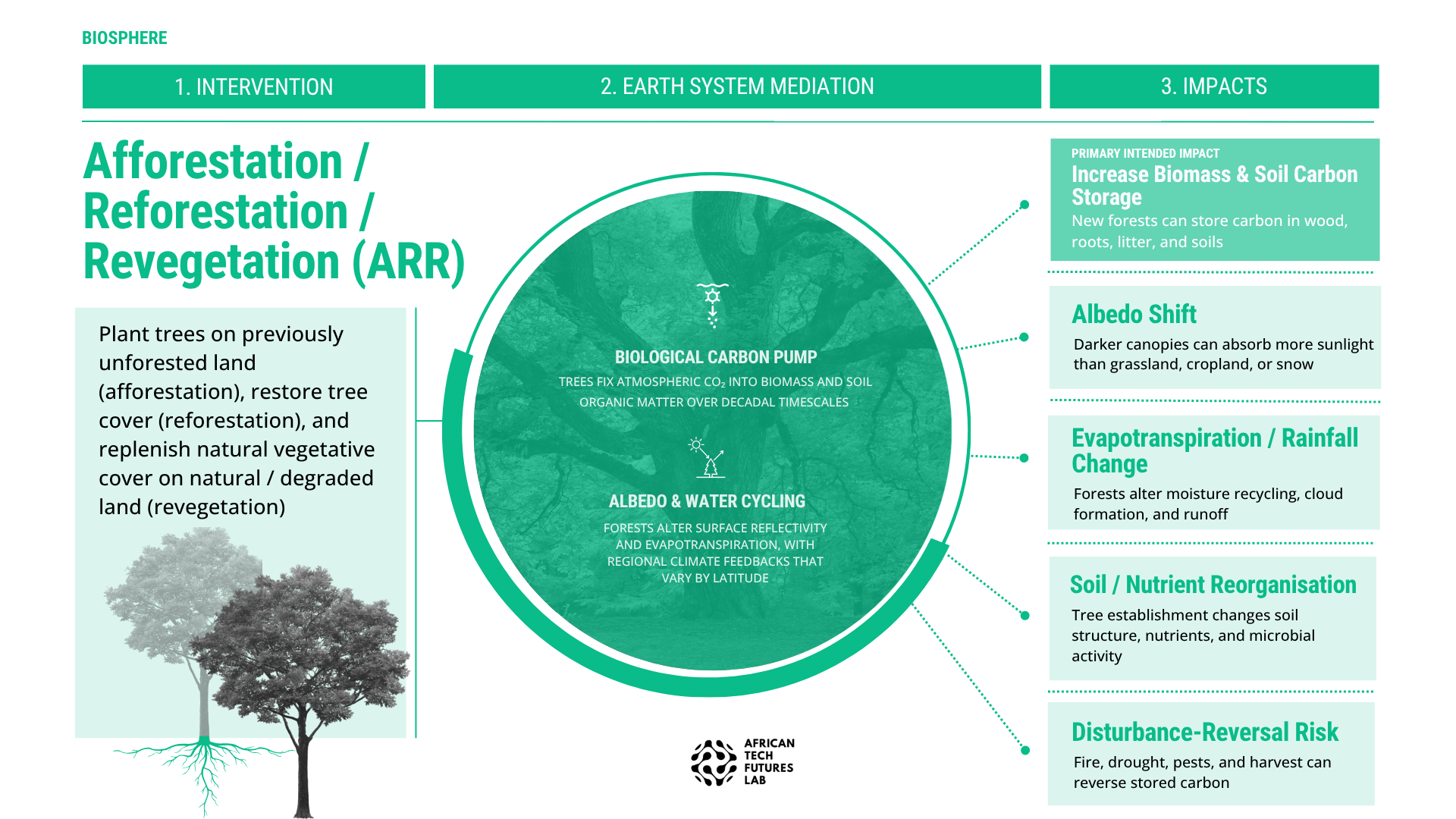
Afforestation / Reforestation / Revegetation (ARR)
This climate intervention technique works by planting trees on previously unforested land (afforestation), restore tree cover (reforestation), and replenish natural vegetative cover on natural / degraded land (revegetation), and it would be mediated by the following key Earth systems: Biological Carbon Pump and Albedo & Water Cycling. A number of impacts and outcomes would be co-produced, including Increase Biomass & Soil Carbon Storage, Albedo Shift, Evapotranspiration / Rainfall Change, Soil / Nutrient Reorganisation, and Disturbance-Reversal Risk.
-
![]()
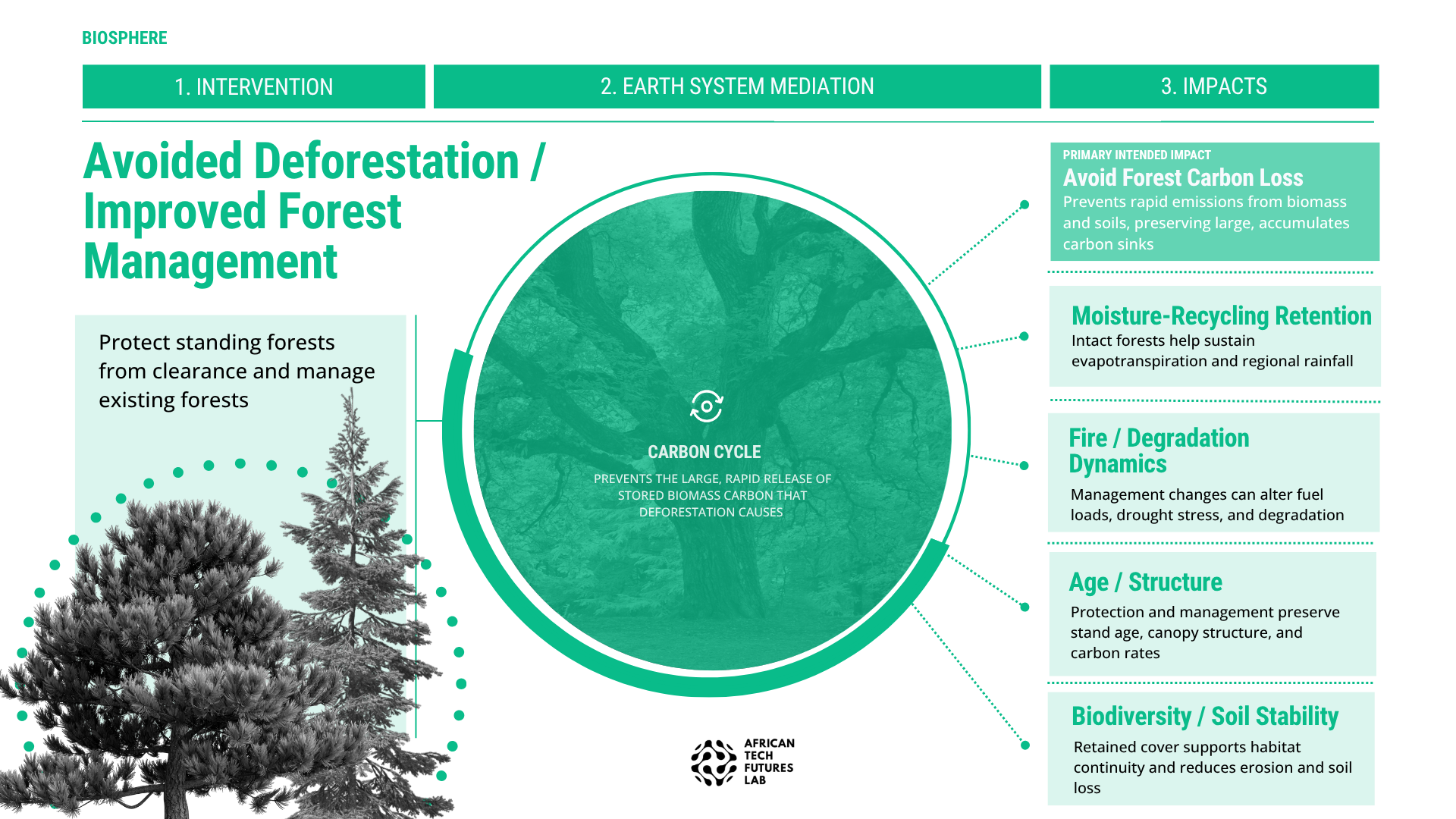
Avoided Deforestation / Improved Forest Management
This climate intervention technique works by protecting standing forests from clearance and managing existing forests, and it would be mediated by the following key Earth systems: Carbon Cycle. A number of impacts and outcomes would be co-produced, including Avoid Forest Carbon Loss, Moisture-Recycling Retention, Fire / Degradation Dynamics, Age / Structure, and Biodiversity / Soil Stability.
-
![]()
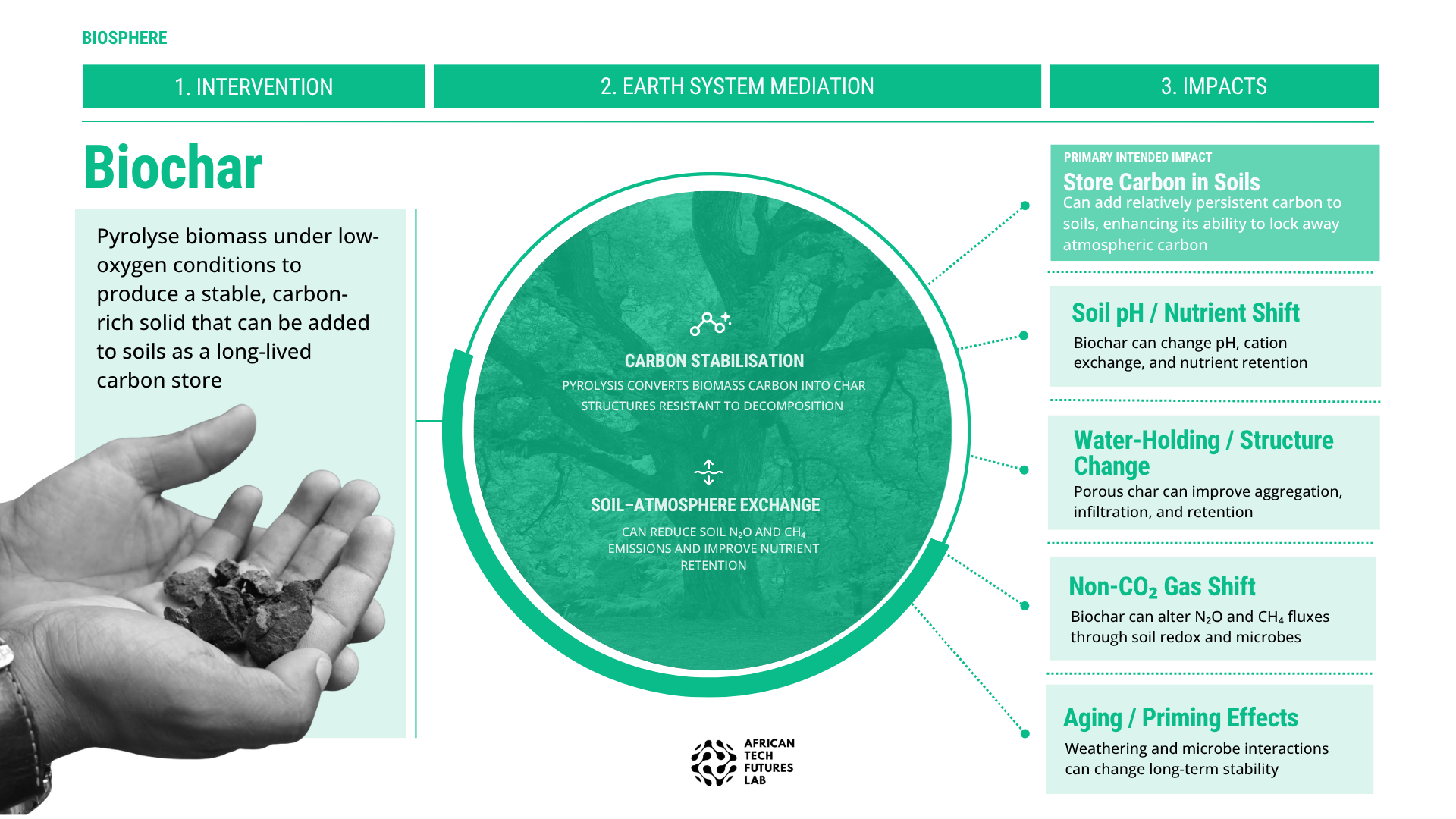
Biochar
This climate intervention technique works by pyrolysing biomass under low-oxygen conditions to produce a stable, carbon-rich solid that can be added to soils as a long-lived carbon store, and it would be mediated by the following key Earth systems: Carbon Stabilisation and Soil–Atmosphere Exchange. A number of impacts and outcomes would be co-produced, including Store Carbon in Soils, Soil pH / Nutrient Shift, Water-Holding / Structure Change, Non-CO₂ Gas Shift, and Aging / Priming Effects.
-
![]()
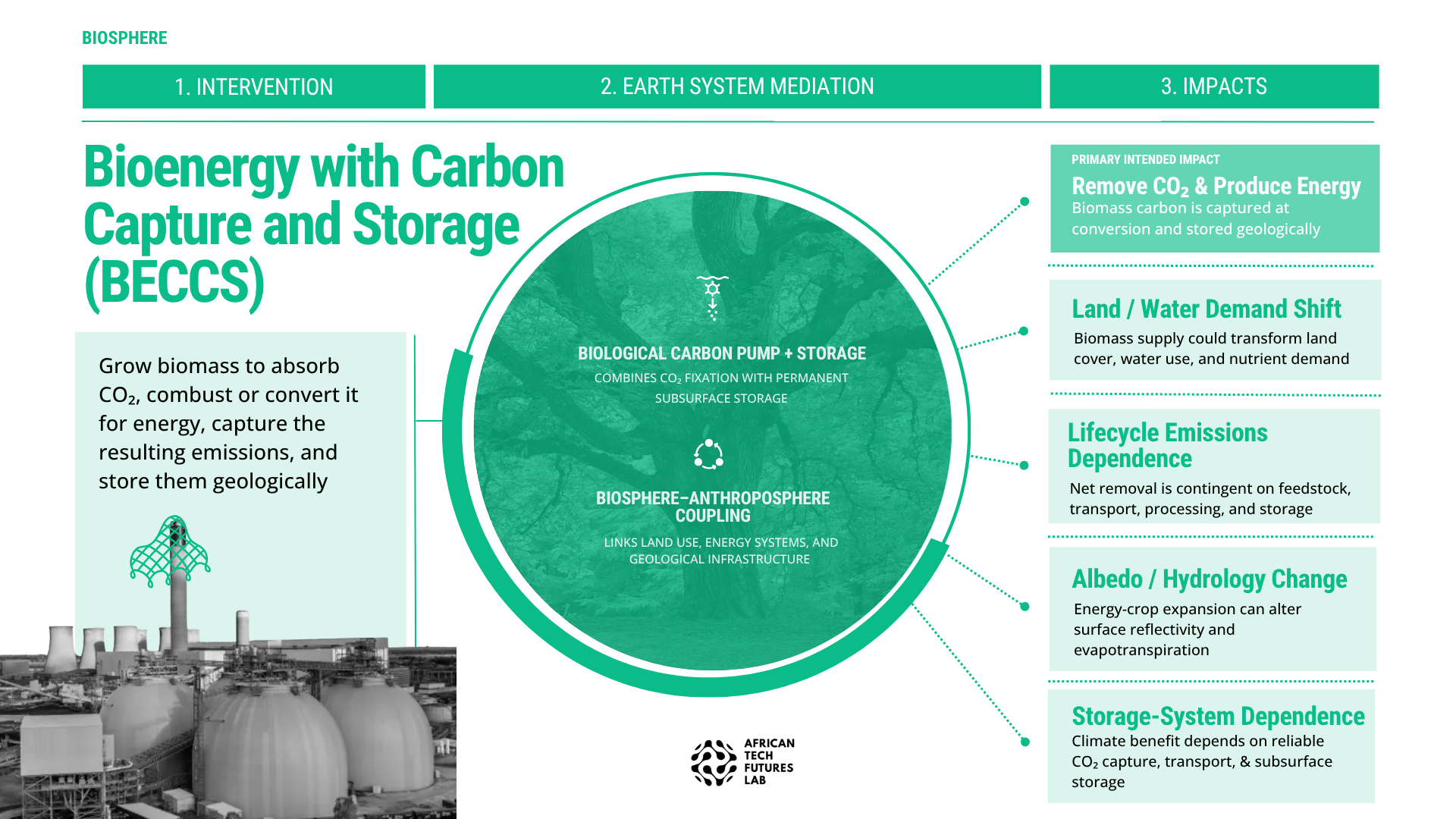
Bioenergy with Carbon Capture and Storage (BECCS)
This climate intervention technique works by growing biomass to absorb CO₂, combusting or converting it for energy, capturing the resulting emissions, and storing them geologically, and it would be mediated by the following key Earth systems: Biological Carbon Pump + Storage and Biosphere–Anthroposphere Coupling. A number of impacts and outcomes would be co-produced, including Remove CO₂ & Produce Energy, Land / Water Demand Shift, Lifecycle Emissions Dependence, Albedo / Hydrology Change, and Storage-System Dependence.
-
![]()
Biofilters / Biotrickling Filters for Methane-dilute Off-gas
This climate intervention technique works by passing dilute methane-containing waste streams through packed biological filter beds where methanotrophic bacteria oxidise the gas before it is vented to the atmosphere, and it would be mediated by the following key Earth systems: Methane Oxidation and Anthroposphere–Biosphere Coupling. A number of impacts and outcomes would be co-produced, including Oxidise Dilute Methane Biologically, Mass-Transfer / Residence-Time Limit, Moisture / pH / Nutrient Control Necessary, Pressure Drop / Clogging Risk, and Heat / CO₂ Production.
-
![]()
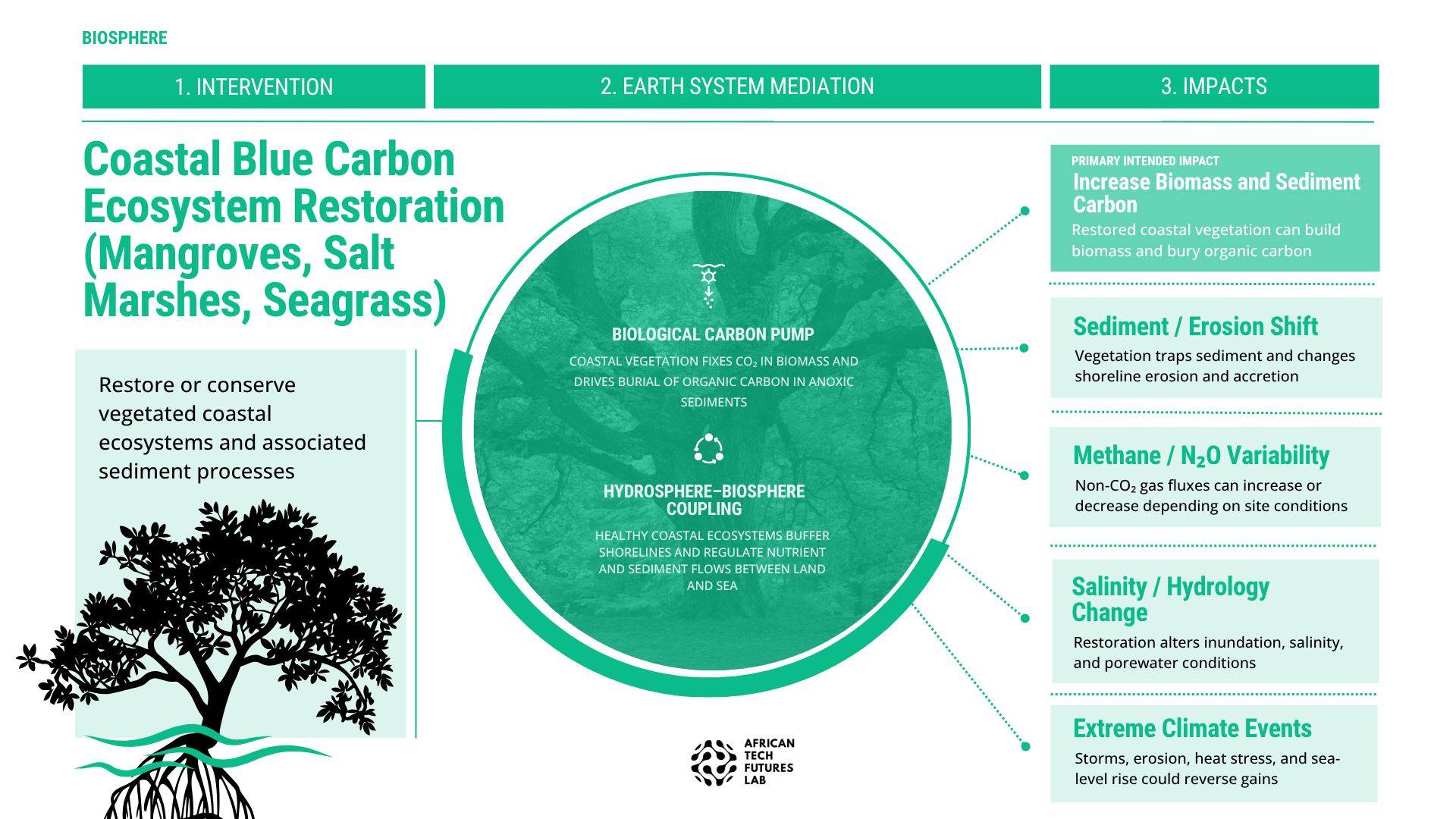
Coastal Blue Carbon Ecosystem Restoration (mangroves, salt marshes, seagrass)
This climate intervention technique works by restoring or conserve vegetated coastal ecosystems and associated sediment processes, and it would be mediated by the following key Earth systems: Biological Carbon Pump and Hydrosphere–Biosphere Coupling. A number of impacts and outcomes would be co-produced, including Increase Biomass and Sediment Carbon, Sediment / Erosion Shift, Methane / N₂O Variability, Salinity / Hydrology Change, and Extreme Climate Events.
-
![]()
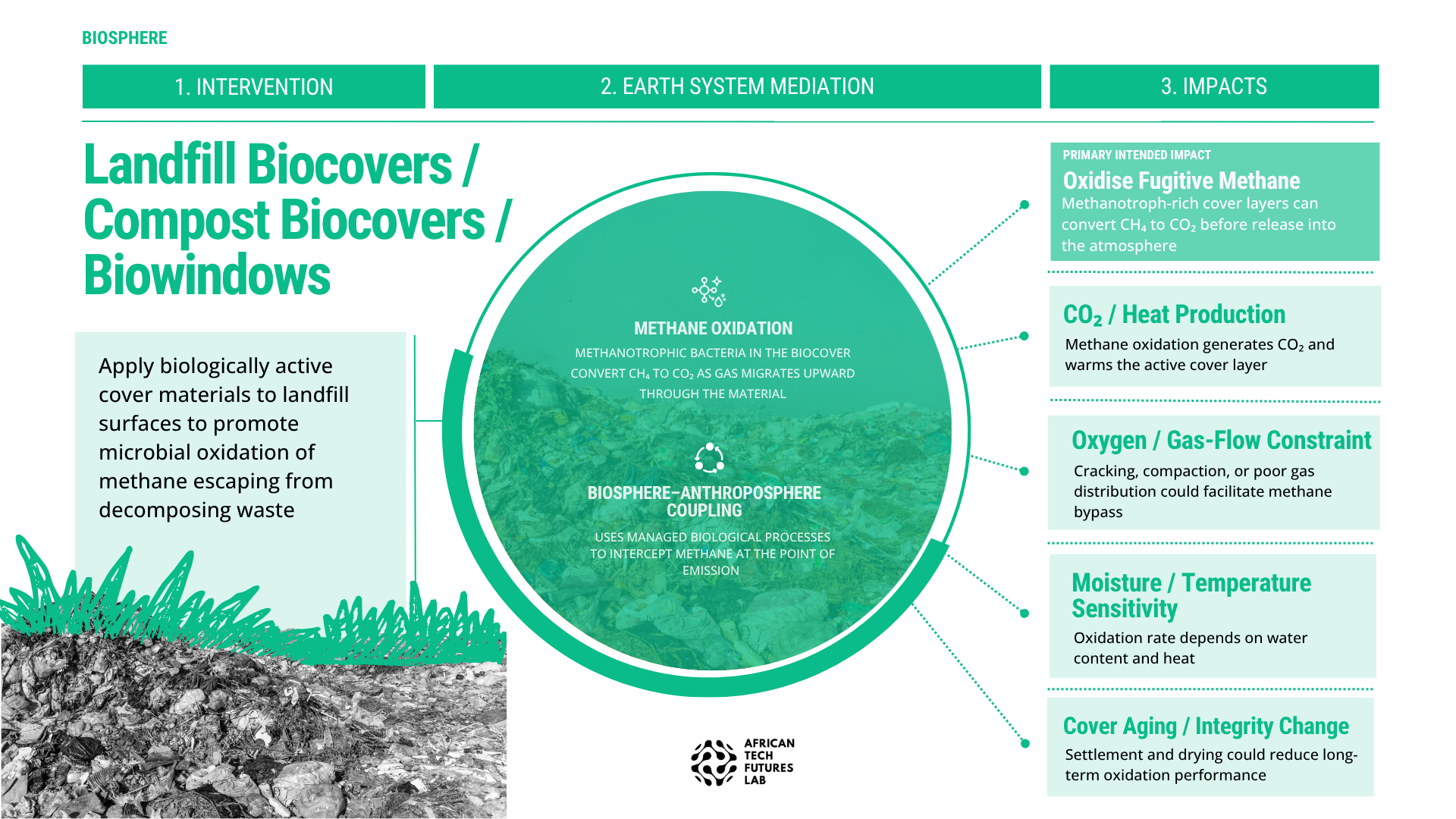
Landfill Biocovers / Compost Biocovers / Biowindows
This climate intervention technique works by applying biologically active cover materials to landfill surfaces to promote microbial oxidation of methane escaping from decomposing waste, and it would be mediated by the following key Earth systems: Methane Oxidation and Biosphere–Anthroposphere Coupling. A number of impacts and outcomes would be co-produced, including Oxidise Fugitive Methane, CO₂ / Heat Production, Oxygen / Gas-Flow Constraint, Moisture / Temperature Sensitivity, and Cover Aging / Integrity Change.
-
![]()
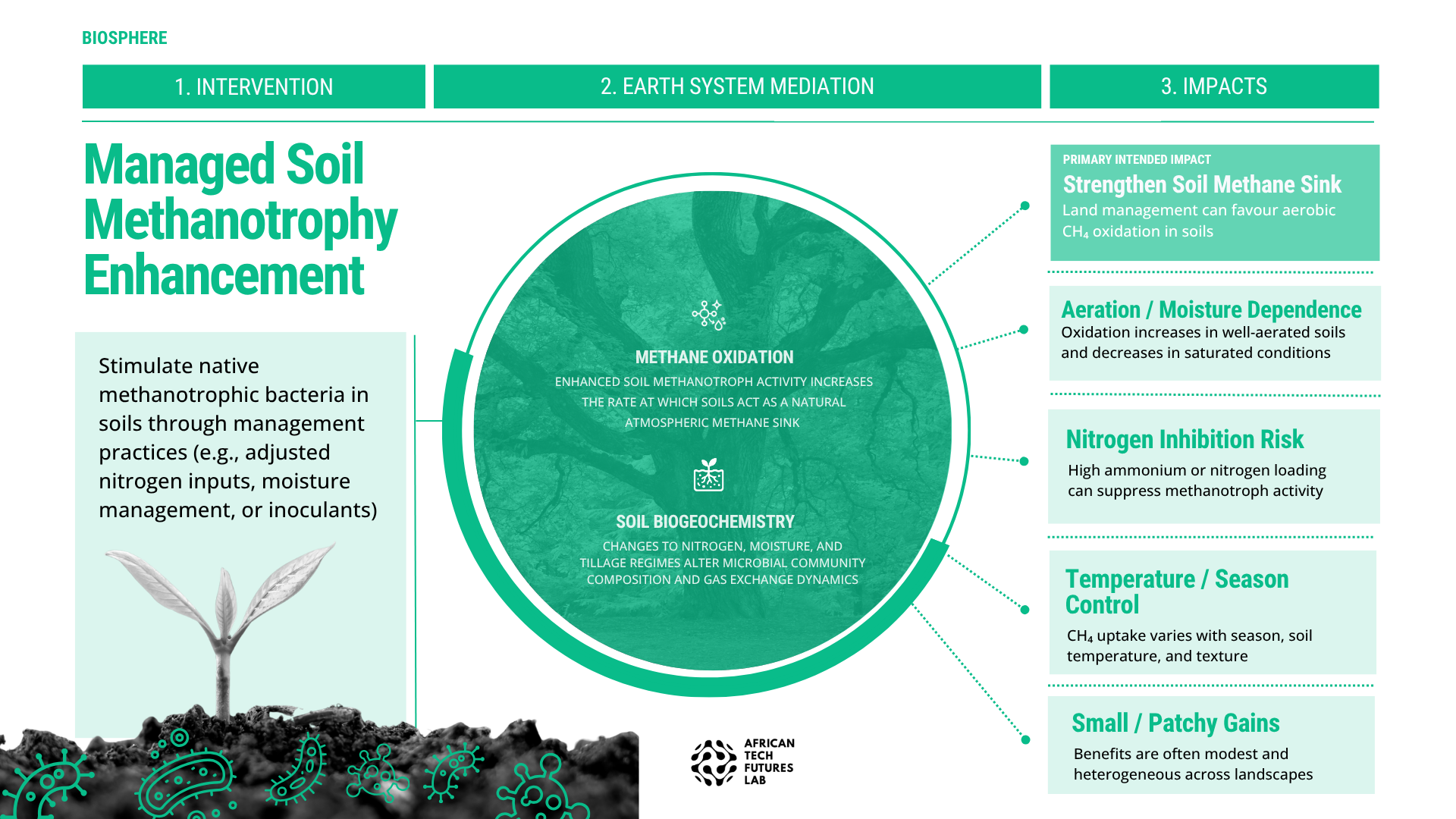
Managed Soil Methanotrophy Enhancement
This climate intervention technique works by stimulating native methanotrophic bacteria in soils through management practices (e.g., adjusted nitrogen inputs, moisture management, or inoculants), and it would be mediated by the following key Earth systems: Methane Oxidation and Soil Biogeochemistry. A number of impacts and outcomes would be co-produced, including Strengthen Soil Methane Sink, Aeration / Moisture Dependence, Nitrogen Inhibition Risk, Temperature / Season Control, and Small / Patchy Gains.
-
![]()
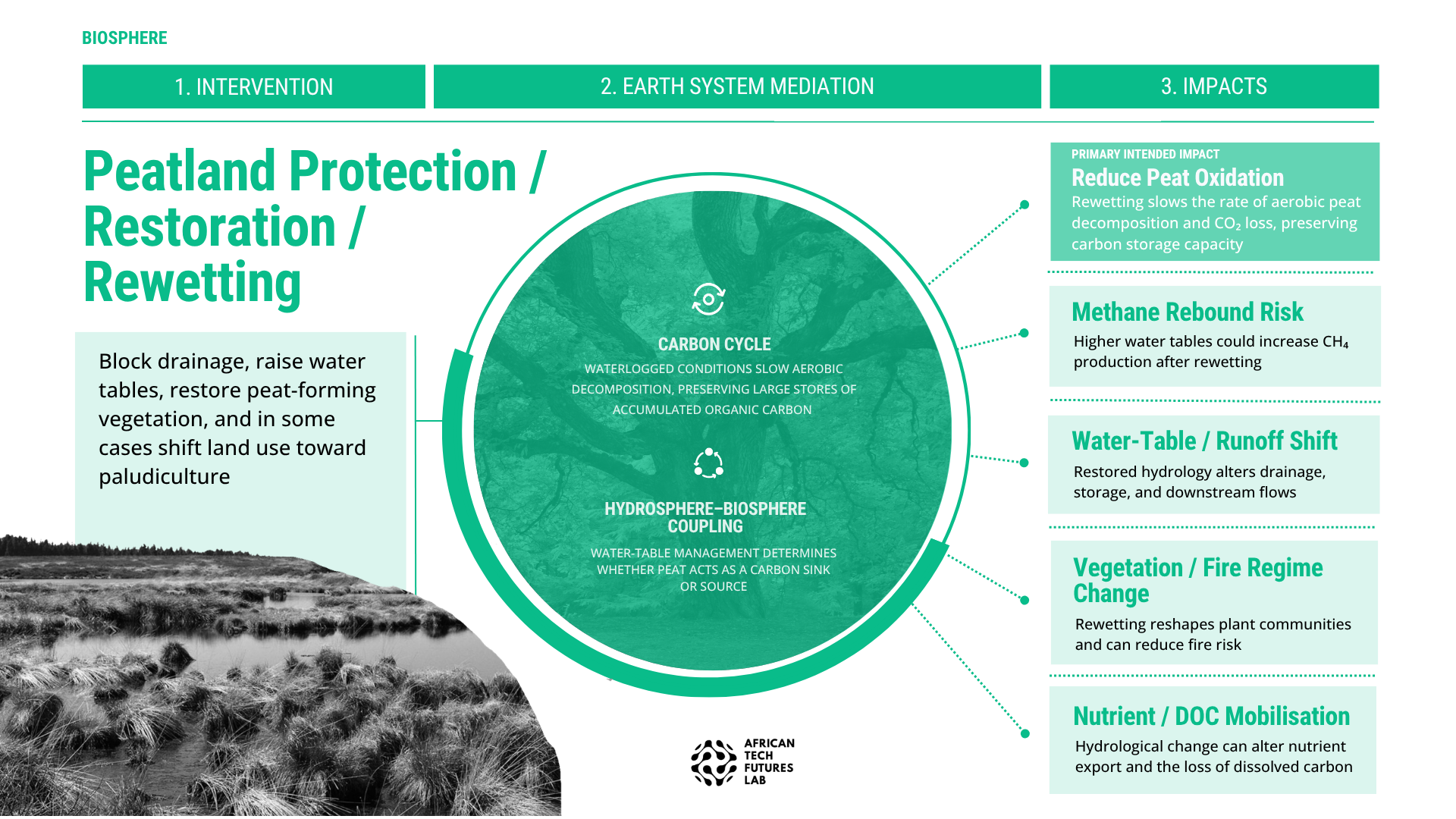
Peatland Protection / Restoration / Rewetting
This climate intervention technique works by blocking drainage, raising water tables, restoring peat-forming vegetation, and in some cases shifting land use toward paludiculture, and it would be mediated by the following key Earth systems: Carbon Cycle and Hydrosphere–Biosphere Coupling. A number of impacts and outcomes would be co-produced, including Reduce Peat Oxidation, Methane Rebound Risk, Water-Table / Runoff Shift, Vegetation / Fire Regime Change, and Nutrient / DOC Mobilisation.
-
![]()
Reindeer herding / large-herbivore management for albedo–permafrost effects
This climate intervention technique works by managing grazing density and seasonal movement of large herbivores to reduce shrubification, compact winter snow, and alter vegetation and surface-energy exchange in tundra landscapes, and it would be mediated by the following key Earth systems: Biosphere–Cryosphere–Hydrosphere Coupling and Vegetation–Albedo Feedback. A number of impacts and outcomes would be co-produced, including Cool Soils via Grazing Effects, Winter Snow-Insulation Shift, Vegetation / Albedo Change, Permafrost / Active-Layer Response, and Patchy Carbon-Flux Response.
-
![]()
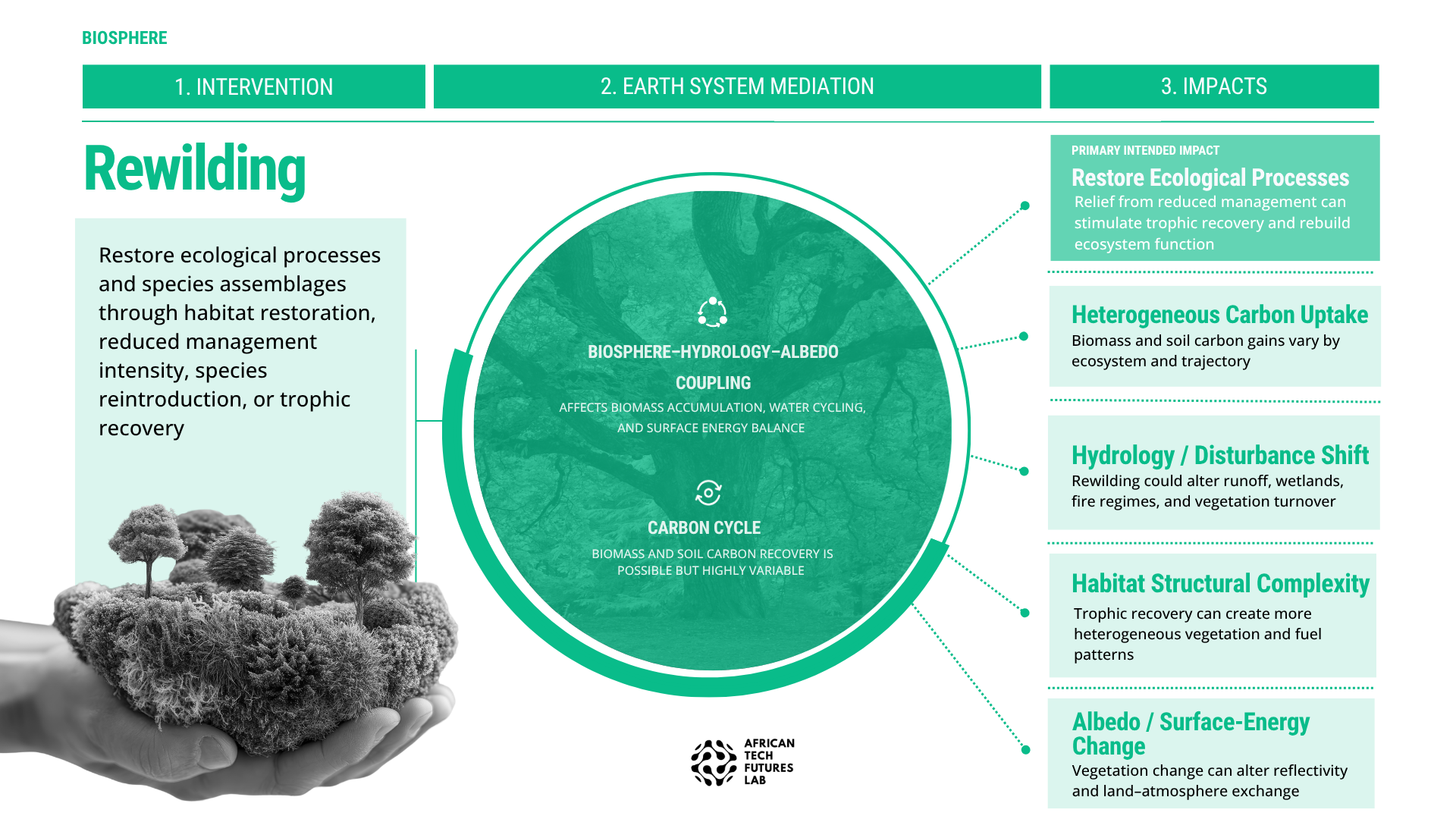
Rewilding
This climate intervention technique works by restoring ecological processes and species assemblages through habitat restoration, reduced management intensity, species reintroduction, or trophic recovery, and it would be mediated by the following key Earth systems: Biosphere–Hydrology–Albedo Coupling and Carbon Cycle. A number of impacts and outcomes would be co-produced, including Restore Ecological Processes, Heterogeneous Carbon Uptake, Hydrology / Disturbance Shift, Habitat Structural Complexity, and Albedo / Surface-Energy Change.
-
![]()
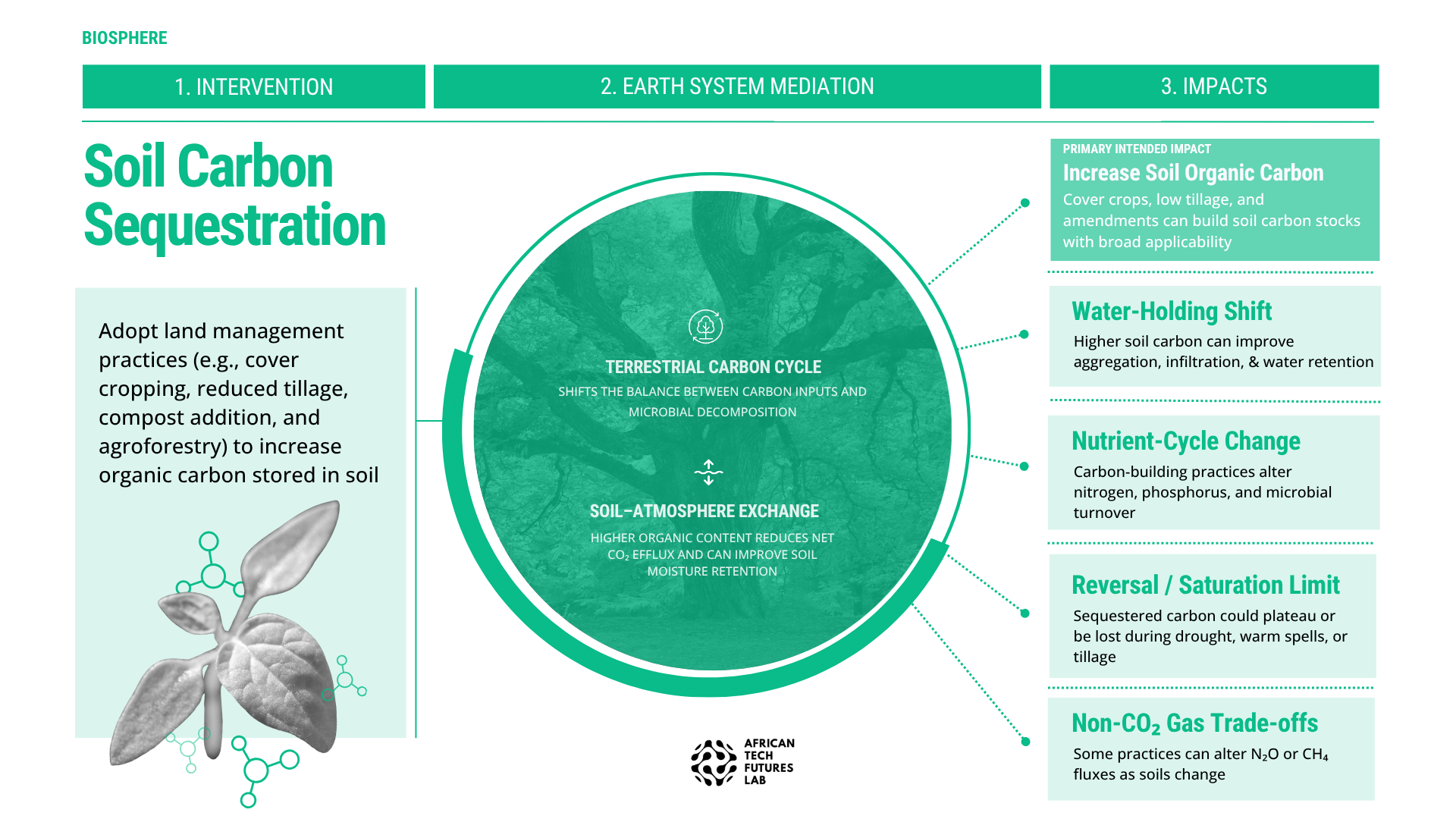
Soil Carbon Sequestration
This climate intervention technique works by adopting land management practices (e.g., cover cropping, reduced tillage, compost addition, and agroforestry) to increase organic carbon stored in soil, and it would be mediated by the following key Earth systems: Terrestrial Carbon Cycle and Soil–Atmosphere Exchange. A number of impacts and outcomes would be co-produced, including Increase Soil Organic Carbon, Water-Holding Shift, Nutrient-Cycle Change, Reversal / Saturation Limit, and Non-CO₂ Gas Trade-offs.
-
![]()
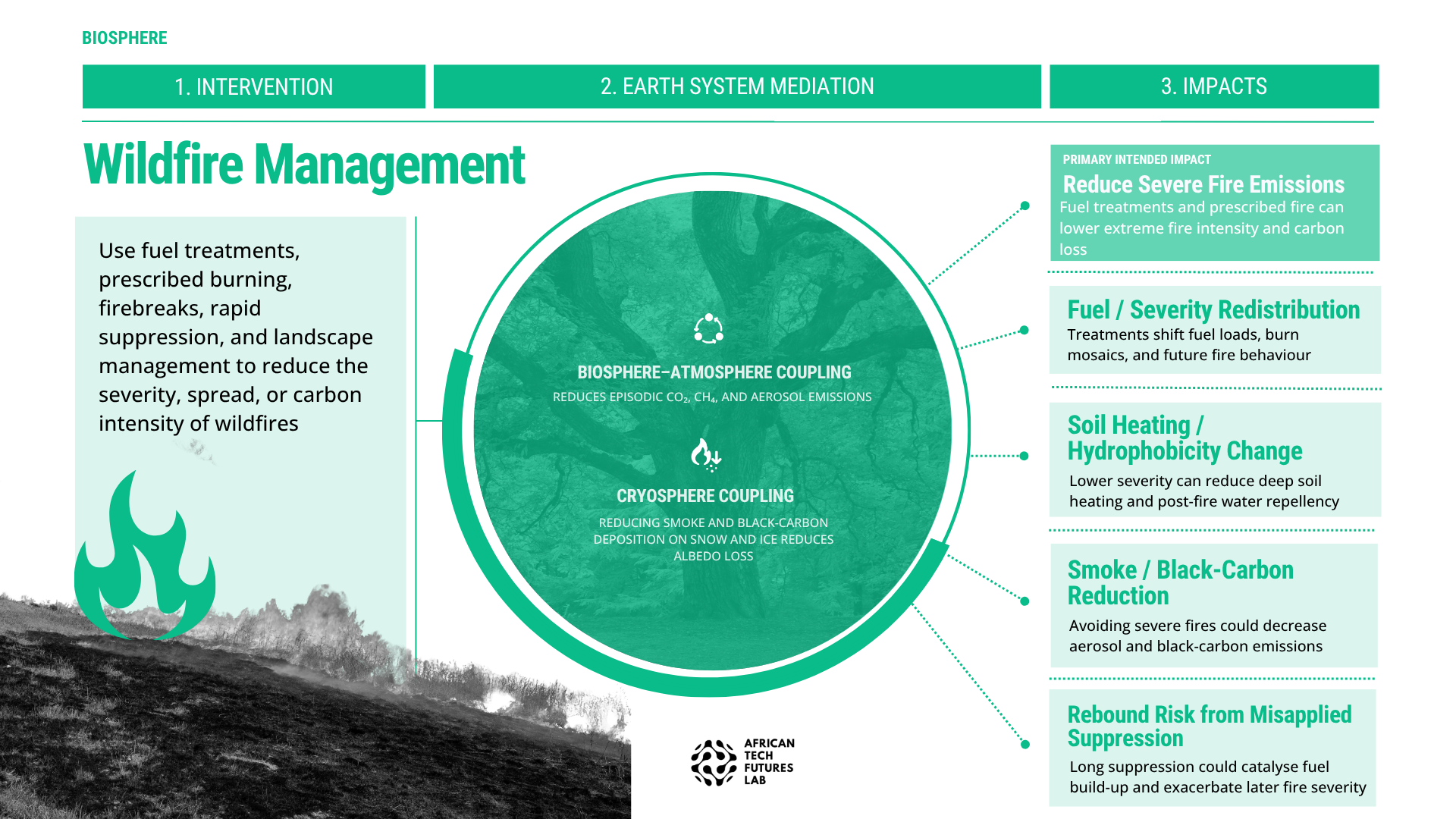
Wildfire management
This climate intervention technique works by using fuel treatments, prescribed burning, firebreaks, rapid suppression, and landscape management to reduce the severity, spread, or carbon intensity of wildfires, and it would be mediated by the following key Earth systems: Biosphere–Atmosphere Coupling and Cryosphere Coupling. A number of impacts and outcomes would be co-produced, including Reduce Severe Fire Emissions, Fuel / Severity Redistribution, Soil Heating / Hydrophobicity Change, Smoke / Black-Carbon Reduction, and Rebound Risk from Misapplied Suppression.


Previous
Previous
Cryosphere
Next
Next