
Report: The Future of Carbon Dioxide Removal in Africa
Read and download the full report.
Companion Documents
Carbon Dioxide Removal: A Primer
A short explainer written for practitioners and decision-makers working on climate and development in Africa and globally who have limited familiarity with the CDR space.
Consultation Methodology Note
Outlines the design, analytical framework, verification procedures, and constraints from the stakeholder consultation process.
Feasibility, Opportunity, and the Choices Ahead.
Carbon dioxide removal (CDR), a technological approach of taking CO₂ from the atmosphere and durably storing it, is moving from a modelled assumption into an emerging field of policy, investment, and deployment. Africa is increasingly positioned both as a potential source of removals for global buyers and as a possible beneficiary of new finance, agricultural gains, ecosystem restoration, jobs, and industrial learning.
But CDR activity on the continent remains early, evidence is uneven, and many of the markets, standards, and technologies shaping the field are designed and controlled elsewhere. This report assesses where and how different CDR approaches may align or misalign with African development priorities and climate goals.
The bottom line
African countries should neither ignore CDR nor bet major developmental outcomes on it. Instead, the strongest near-term strategy is selective, place- and pathway-specific engagement: building foundations that create value across sectors, testing projects against development and climate criteria, protecting rights and locally retained value, and helping shape market rules before they are set elsewhere.
Why it matters
The choices being made now shape how Africa participates in a future carbon removal economy: whether countries primarily host projects and supply carbon credits, or also build scientific capability, retain economic value, shape global rules, and use CDR to advance broader development priorities.
Five key findings
There is no single African CDR pathway. Broad claims about Africa’s land, minerals, biomass, renewable energy, or geological potential obscure important differences between places and technologies. Feasibility, climate integrity, and public value depend on the specific method, location, infrastructure, institutions, resources, trade-offs, and safeguards involved.
The development case is plausible, but conditional. CDR could support climate finance, agricultural productivity, restoration, waste management, jobs, and industrial learning. But these benefits do not follow automatically from a carbon-removal project. Proposals should clearly identify who benefits, how those benefits will be measured, and whether CDR is a better use of land, energy, water, biomass, capital, and public attention than available alternatives.
The market remains fragile and largely shaped outside Africa. Voluntary carbon markets and corporate buyers have enabled the first wave of projects, but demand remains concentrated, prices are uncertain, and many standards and market rules are set elsewhere. More durable compliance markets may emerge, but access is far from guaranteed.
Evidence and local capacity remain major constraints. Africa shares the global challenge of limited long-term CDR evidence, but also faces gaps in geological and resource data, laboratories, monitoring and verification systems, and research capacity. Building these capabilities is important not only for CDR, but for agriculture, energy, minerals, infrastructure, and climate planning more broadly.
Near-term prospects vary significantly by approach. Biochar and enhanced rock weathering warrant broad experimentation because of their relatively lower infrastructure requirements, growing market traction, and potential agricultural and local value-chain benefits. Afforestation and reforestation will remain important but require strong safeguards around integrity, land, rights, and reversibility. Direct air capture may be promising in specific locations such as the Kenyan Rift. Bioenergy with carbon capture and ocean alkalinity enhancement currently face greater technical, infrastructure, environmental, or governance uncertainty.
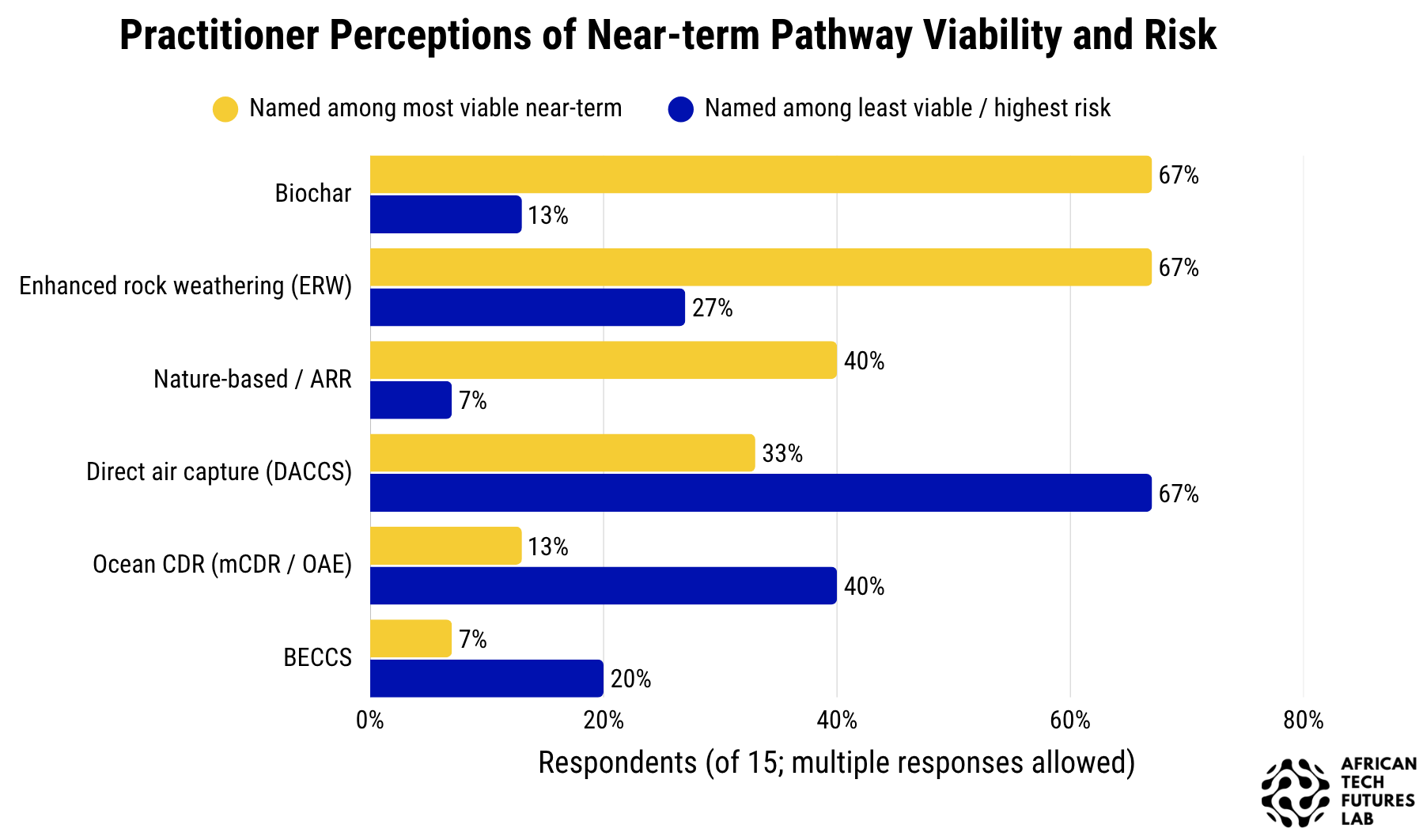
No-regrets CDR engagement options for Africa
Across these approaches, the report identifies several no-regrets priorities: engage where place-specific advantages are demonstrable; build cross-sectoral public capability; define and secure local value, rights, and liability before scale; embed CDR in sectoral priorities and compare it with alternatives; and ensure African institutions participate in shaping the standards and rules that will determine future market access.
Ultimately, Africa’s most important near-term asset is not any single CDR technology. It is the ability to judge proposals on African terms using evidence, institutions, sector expertise, rights, and bargaining power to determine where engagement makes sense, where more research is needed, and where projects should not proceed.
Acknowledgements
The stakeholder interviews and the synthesis presented across this series were led by Rose M. Mutiso and Trisha Patel. We are grateful to the CDR Project Advisors—Habiba Daggash, Julie Gosalvez, Anu Khan, Bilha Ndirangu, and Patrick McGrath—for their guidance throughout this project, as well as to the many practitioners and experts who generously shared their time and perspectives. We thank Naima Kane and Adam Salzman for their contributions to the background research underlying this report series, and Grace Tamble and Eleanor Mayrhofer for their editorial and design support.
This work was supported by the Schmidt Family Foundation. The analysis and conclusions presented here are those of the authors and do not necessarily reflect the views of the funder.
