
The Bottom Line: Electric vehicles are becoming affordable in Africa far faster than expected. New research across 52 African countries finds that battery electric vehicles (BEVs) will be cheaper to own than petrol vehicles in every country and passenger segment well before 2040, without subsidies and despite high financing costs. But the transition will not happen at the same pace everywhere. Two-wheelers get there first, around 2030; cars last. Financing costs, policies such as import duties, and the timing of government interventions will play a decisive role in determining where and how quickly adoption takes off.
Why It Matters:
The findings overturn a long-held assumption. Influential outlooks expect petrol and diesel vehicles to dominate African roads through mid-century. With most e-mobility momentum in motorcycles, few expected the tipping point to reach cars so quickly.
BEVs will become cost-competitive whether or not governments act. Falling global battery prices will do most of the work. Governments that prepare now will shape who benefits; those that don’t may find existing policies penalizing the cleaner and soon to be cheaper option.
Our new study maps Africa’s approaching BEV cost tipping point
A recent study published in Nature Energy provides new, comprehensive evidence on the changing economics of passenger battery electric vehicles (BEVs) on the African continent. It compares BEVs to internal combustion engine (ICE) vehicles across 52 African countries, six passenger vehicle segments and three time frames: 2025, 2030 and 2040.
The study uses a techno-economic model to analyse lifetime cost, covering purchase, financing, fuel or electricity, maintenance and insurance, minus resale value. Three assumptions matter for understanding the results:
Excludes taxes and subsidies. The model excludes taxes, import duties and subsidies, giving a baseline against which to measure effects of real-world policies.
Assumes off-grid solar charging. Each BEV purchase includes the full cost of a solar-and-battery system, including financing, so no reliable grid is assumed.
Compares new vehicles only. We analyse new vehicles only because reliable data on used BEVs does not yet exist. This is an important caveat in African markets dominated by cheap imported secondhand petrol cars, though an influx of used BEVs from China, and potentially Europe, could change the landscape.
Key findings
1. BEVs will become cheaper to own across every segment, two-wheelers first and cars last
New BEVs are not yet cheaper than conventional ICE vehicles across Africa today, but by 2040, across all countries and segments, they will be (Figure 1).
Two-wheelers are leading the charge, likely reaching lifetime cost parity with conventional vehicles in nearly all African countries by 2030. Small cars lag and will reach parity closer to 2040, with minibuses falling somewhere in between. Much of this shift is driven by expected reductions in battery and BEV costs over time. Here we assume that battery pack costs fall 22% each time global battery production doubles, a logic known as an experience or learning curve.
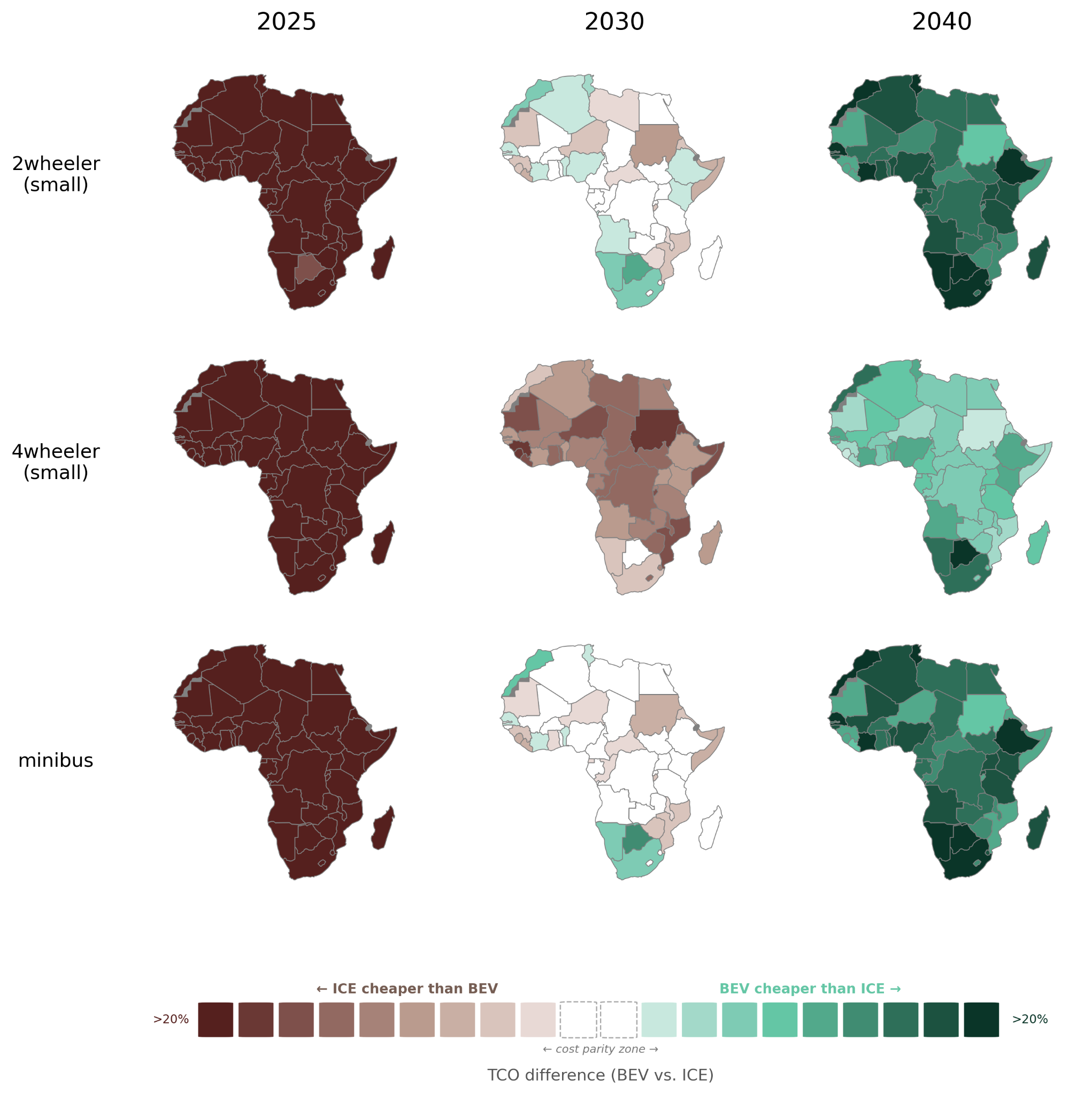
Figure 1 │ A continent-wide cost shift is underway. Comparative lifetime cost of new BEVs versus new petrol (ICE) vehicles (percent-difference). Red: petrol is cheaper; green: electric is cheaper. Adapted from Noll et al. 2026, Nature Energy.
2. Financing, not technology, is the single biggest barrier to BEV affordability
Financing (or borrowing) costs explain most of the country-level variance as well as the parity delay for cars. These costs reflect both technology-specific risk, as BEVs remain relatively new to African markets, and, more significantly, country-level risk. The study finds that financing costs can be substantial enough to surpass the upfront vehicle cost itself, in some segments by a wide margin. In a cash purchase scenario, BEVs would already be competitive by 2030.
Financing costs also disproportionately affect segments where the initial price gap remains substantial, most notably small cars, where financing costs alone reach 150% of the vehicle price in some countries.
3. Charging costs matter far less than expected, even when relying on off-grid solar
The study finds that even when factoring in the outright purchase and financing of a solar off-grid charging system, sized to meet daily driving needs and allowing drivers to operate independently from the grid, charging has only a small effect on lifetime cost, particularly for cars and minibuses. Given how affordable and widely available off-grid solar has become across the continent, this is an exciting finding. Accessible solar may well be a quiet enabler of faster BEV uptake in Africa.
4. Policy distortions will determine how fast and where BEV adoption materializes
Real markets have taxes and duties, and adding them back can push BEV and petrol vehicle economics in opposite directions. Import duties are the clearest case.
Rated as a percentage of a vehicle's cost-insurance-freight (CIF) price, import duties disproportionately hurt BEVs given their higher upfront cost. Figure 2 illustrates this effect in South Africa and Kenya. In South Africa, BEVs face higher import duties than conventional cars, directly widening their affordability gap. In Kenya, the duty rate is the same for both technologies, yet the relative lifetime cost gap still widens by four percentage points, driven by the higher BEV sticker price and associated financing costs. Seemingly neutral policies can therefore produce unequal outcomes.
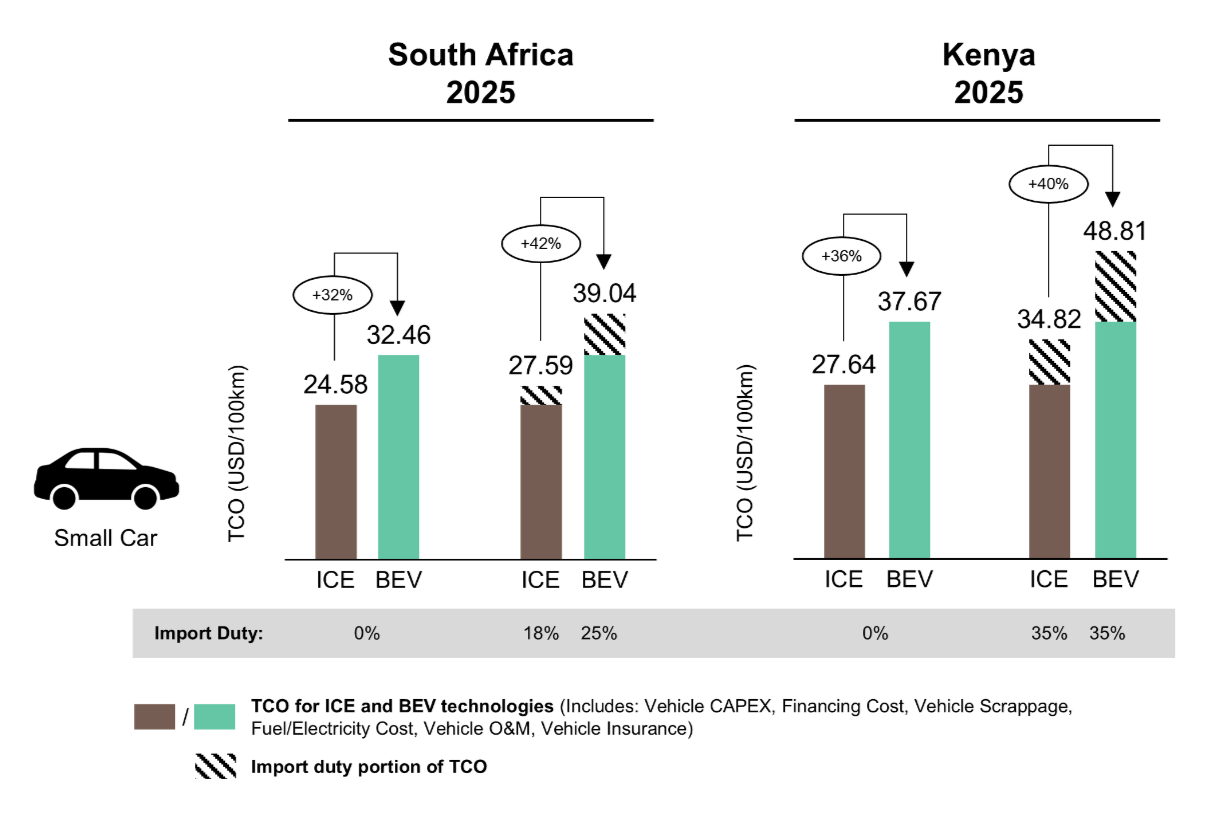
Figure 2 │ Seemingly neutral policies can have unequal outcomes. Lifetime cost of a small car in 2025 (US$ per 100 km), with and without import duties; hatching shows the duty. Author’s calculations and visualization.
5. The “right” policy response will look different depending on a country's relative readiness
There is no single policy pathway that will work for every African country. More granular, country-specific analysis is needed as policies rarely operate in isolation. They are designed in combination, and their net effect on BEV affordability varies widely by context. Key areas to examine include import duties, value-added tax (VAT), fuel taxes, and electricity tariffs. In other words, any policy that could tilt the playing field against BEVs relative to ICE vehicles.
While dedicated policy support mechanisms and strategies for BEVs are still taking shape in leading countries like Rwanda, Ethiopia and Kenya, they are also quickly expanding to other countries across the continent. The African Union’s recently passed Continental Framework on Electric Mobility is further building momentum for decisive and collective action. The time is now to shape the right policy response.
The BEV transition is coming, but smart policy will shape its success
The economics tell an encouraging story that bears repeating. BEVs are on track to become cost-competitive across African markets even without policy support. Against this backdrop, two policy pathways seem plausible.
On the one hand, for African governments where climate action competes with more immediate development priorities, waiting is not an unreasonable position as global electrification will bring BEV costs down regardless. But there is a difference between waiting and being unprepared. Governments that act early will shape not just how fast BEVs arrive, but who benefits and on what terms.
Conversely, there is growing sentiment for a strong policy push that accelerates BEV adoption by outright banning ICE vehicle imports. Following in the footsteps of Ethiopia, Burundi recently announced that as of January 1, 2027, every new passenger car ordered for import must be electric or hybrid. More countries in the eastern bloc may follow. For some countries and some vehicle segments (mainly electric 2-wheelers), this policy play makes sense; for others, the economics are simply not yet there and will end up putting immense pressure on consumers.
The importance of policy timing here cannot be overstated and requires a concerted effort to continuously monitor cost dynamics over time and across different vehicle segments. Three priorities stand out:
Stop penalizing BEVs inadvertently. Create supportive policy environments by reviewing import duties, VAT and customs valuations, and track costs by segment so measures like import bans arrive when the economics support them.
Cut the cost of finance. Guarantees, blended finance and cross-country pools of vehicle loans lower risk in a way purchase subsidies cannot. Development banks, international financial institutions and impact investors are well placed to lead.
Look beyond transport. Early movers can capture industrial upgrading opportunities along the BEV value chain. There is momentum in vehicle assembly, maintenance, battery swapping and solar charging; in batteries, competing with Chinese manufacturing will be hard.
Strong economics alone will not determine the pace of BEV adoption. Financing and policy will decide which countries lead.
