Numerous platforms exist to mobilize diaspora financial capital. Can we do the same for people and their expertise?
Africa’s diaspora has been having a moment—but that moment, so far, has forgotten one crucial element of any diaspora: the people.
The African Union has formally designated the diaspora as Africa’s “sixth region.” Governments court diaspora bonds. Development reports tally remittances with reverence. Headlines celebrate the billions flowing “back home.”
And yet, almost everything about this conversation is financial. Whither the people?
I’ve written in the past about abstraction, and in this case, we’ve reduced people—the richness of their talents, lived experience, networks, positioning, and more—into money. (Interestingly, rhetoric on Africa’s home-based assets runs in the reverse: in addition to our natural resource endowments, we fixate on the booming youth population and the so-called “youth dividend”).
That’s why a recent piece by my good friend Tolu Oni—a brilliant public health researcher and one of Africa’s leading voices on urban health—on the untapped intellectual capital of Africa’s diaspora, landed so sharply for me.
Africa has built serious infrastructure to mobilize diaspora money. In comparison, we’ve done almost nothing to mobilize diaspora mindpower at scale.
That asymmetry is a missed opportunity and a strategic mistake. Especially now, at a moment of global disruption when ideas, expertise, innovation, influence and agenda-setting matter as much as capital.
Why This Gap Matters More Than Ever
Africa’s future is being shaped by massive global forces: climate change, energy transitions, AI, supply chain reconfigurations, shifting geopolitics. Too often, the framings, agendas, and rules of the game for these issues are still set elsewhere—Washington, Brussels, or Beijing—then imposed or thinly “localized” in Africa.
The result is familiar: African nations as passive recipients, rather than active architects, of their own futures.
Closing this gap requires mobilizing all of Africa’s intellectual capital and influence, not just what sits within national borders. That includes Africans in the diaspora, many of whom are embedded in the very institutions and networks where global agendas are shaped, financed, and legitimated.
The diaspora, alongside continent-based Africans who move fluidly through regional and global spaces, are uniquely positioned to bridge the local and the global. Without deliberate platforms to identify, connect, and deploy this expertise, we will continue to squander one of Africa’s most underutilized sources of power.
Needed: Infrastructure to Mobilize the Diaspora’s Intellectual Capital
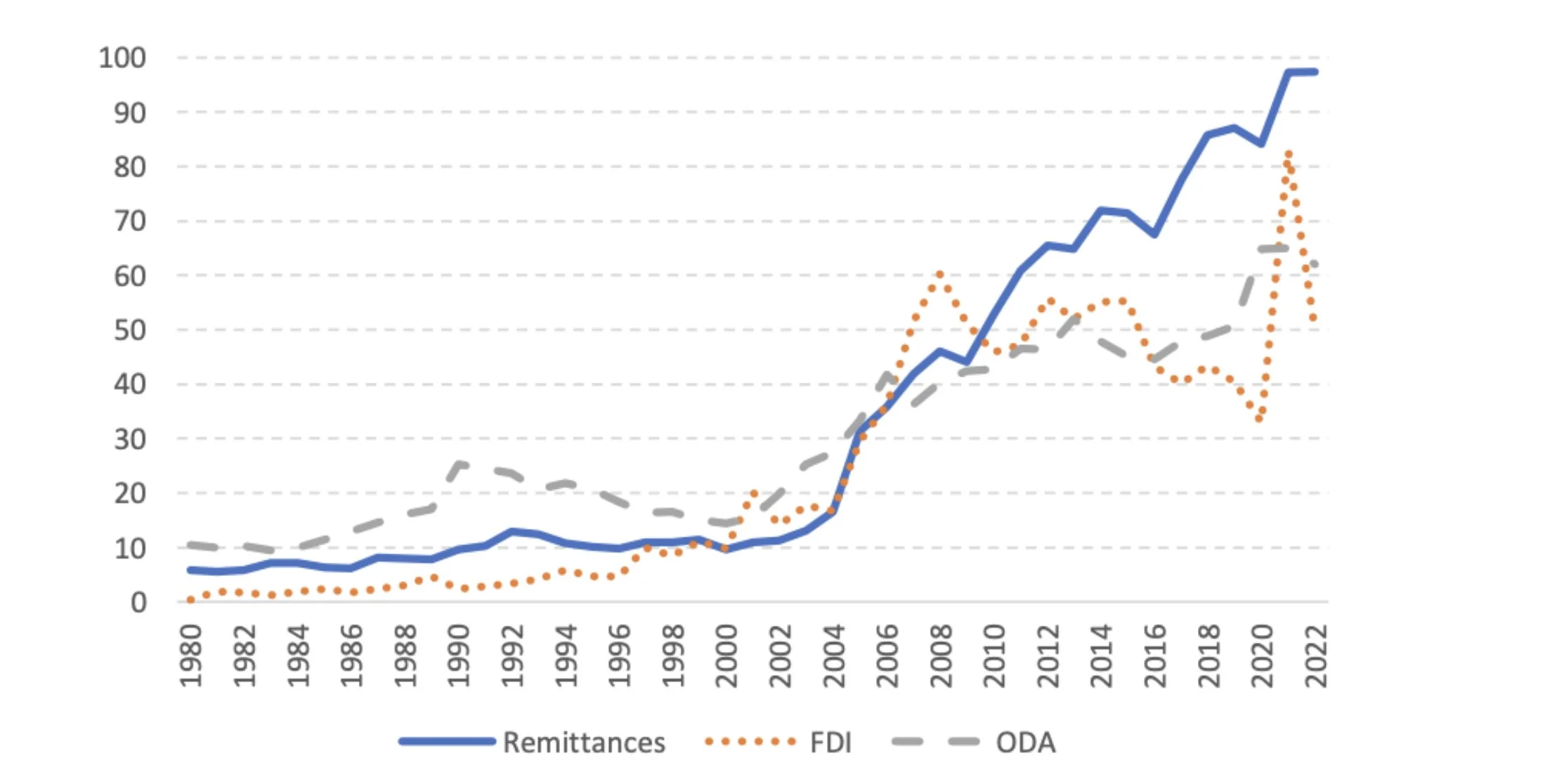
Figure 1: Workers’ remittances, FDI, and ODA flows to Africa in US$ billions, 1980-2022. (Source: World Bank’s WDI and KNOMAD, via AfDB)
So how do we begin marshalling the African intellectual diaspora to fill this gap? Let’s start with what we’ve gotten right with financial capital and the diaspora.
Over decades, we’ve built numerous platforms to mobilize diaspora dollars: digital remittance platforms, specialized investment vehicles, informal savings and investment groups, and even diaspora bonds. This is why the diaspora functions, imperfectly but materially, as a financial region.
At the same time, we’ve paid a lot of rhetorical lip-service to the idea of diaspora’s broader role beyond their remittances. But intellectual capital, like all other forms of capital, doesn’t operate on vibes. Without platforms, intellectual capital doesn’t compound. It withers, unconnected, invisible and unusable.
Now imagine applying the same ambition and ingenuity we’ve dedicated to mobilizing the diaspora’s dollars to its intellectual capital.
The talent exists. African researchers, innovators, entrepreneurs, policy thinkers, and practitioners are everywhere—across the continent and scattered globally. Many hold positions of influence in universities, research institutions, private industry, multilateral organizations, and more.
But that expertise remains structurally disconnected from decision-making. It shows up episodically, informally, often too late—if at all. Brilliant minds work in isolation, their insights trapped in their home institutions, scattered across sectors and geographies with no durable pathways to visibility or influence.
This isn't a talent problem. It's an infrastructure problem.
So what does it actually mean to seriously treat the diaspora as a resource for enriching African prosperity and decisionmaking—not just financially, but intellectually?
Just as financial platforms transformed how diaspora capital flows, intellectual platforms could transform how diaspora expertise shapes Africa's future. The capital doesn't really exist—at scale, with impact—without the platforms of exchange and amplification. The same is true for intellectual capital.
What might these platforms actually look like? There is no single model, because intellectual capital itself is diverse, but there are instructive precedents.
The Carnegie African Diaspora Fellowship Program has funded hundreds of collaborations between diaspora scholars and African institutions over the past decade. Diasporans can also be woven directly into policy processes: Nigeria's 2024 National AI Strategy was co-created by over 120 researchers and practitioners, including diaspora members. Sector-specific platforms could go further still, helping African nonprofits, startups, or public institutions identify board members, advisors, mentors, and reviewers from relevant diaspora communities.
The point is not to converge on a single solution, but to experiment with many. And critically, Africa’s intellectual diaspora is not only abroad, it is also intra-continental, making regional and pan-African connectors just as essential as global ones.
Platforms Are Personal For Me, So I’ve Started One
This question of pipelines and platforms for the diaspora’s intellectual capital is not abstract for me. I've spent my career moving between worlds—physics research labs, African institutions, global policy spaces. For years, I didn't fully recognize what I was doing: functioning as an African intellectual asset, even when the work wasn't explicitly “about Africa.”
That realization clarified something that had been nagging at me for years: mobility and expertise only translate into influence when they are embedded in systems. Individual trajectories—no matter how privileged or well-intentioned—are a weak substitute for durable, shared infrastructure that can turn embodied expertise into collective power.
In a recent piece reflecting on a conversation with my childhood friend and leading African political scientist Ken Opalo, I wrote about how both of us benefited from a particular moment in Kenya’s history when access to elite intellectual networks wasn’t fully gated by wealth. Kenya’s national school system, imperfect as it was, created a pipeline that pulled talented students from across the country into spaces of influence. That pathway helped launch us into global academic and policy worlds.
We cannot keep outsourcing ideas about Africa’s future, nor can we rely on chance or individual hustle to surface African expertise. We need many more Africans—on the continent and in the diaspora—thinking, debating, and shaping futures on African terms. And we need the platforms that make that possible.
I’m putting all my energies now into building one such platform—the African Tech Futures Lab, a virtual think tank designed to connect African expertise across borders and disciplines, and to link it more systematically to the arenas where decisions about technology, development, and the future are actually made. We’ll be launching publicly in early March with an initial cohort of experts and projects. I’ll share more soon here on Substack.
I’m encouraged to see parallel efforts emerging as well. My friend Tolu and her team at Urban Better are also launching a diaspora Hub for urban public health, kicking off with a pulse survey that will be going live soon.
I’d love to see many more initiatives experimenting with creative and diverse ways to build platforms that mobilize Africa’s intellectual capital. If you or someone you know are working on something similar, please do share.
And I’d also love to hear how others are thinking about this. What would it actually take for Africa’s diaspora to function as more than a bank account?
This piece was originally published on Kibao, a Substack newsletter, and is reposted here with permission.
Context note: This piece was sparked by reflections from Urban Better’s Sankofa Dialogue in London and Tolu Oni’s recent writing on diaspora intellectual capital.